Compliance marketing · 9 min read
How to Market a Compliance Business: 6 Channels That Build Trust
· By Alex Lawford
Your product keeps companies out of court, out of the headlines and on the right side of the auditor. Your buyer still needs a committee, a security review and a second opinion before they'll take a demo.
That's the odd thing about marketing a compliance business. You sell safety to people whose job is to avoid risk, and buying from you is itself a risk. Pick the wrong vendor and it's their name on the failed audit.
So the usual growth playbook falls flat. Clever ads don't move a Head of Compliance. Big claims make them nervous. What moves them is proof, and proof that comes from someone other than you.
The six channels below all do the same job in different ways: they lower the risk of saying yes. Here's how each one works for a compliance business, where to start, and a three-number gut check further down for picking the right one first.
One honest exception: none of this works yet if you're still pre-product-market-fit. Fix that first, then come back to this list.
Compliance marketing strategy: what each channel proves
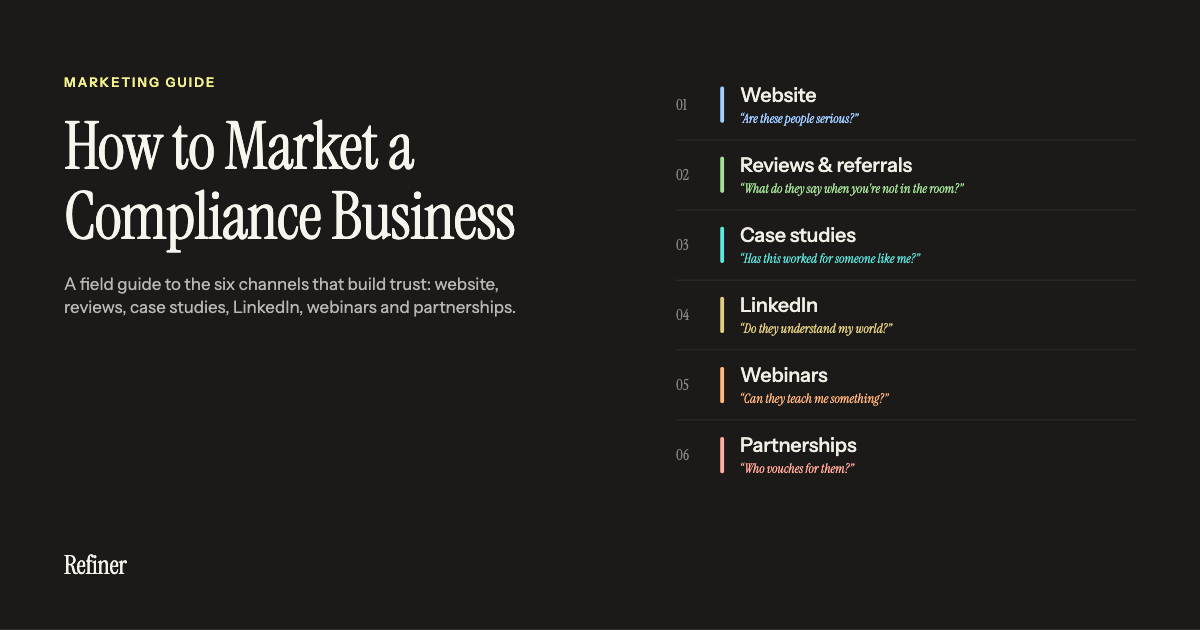
Every compliance buyer is asking the same silent questions. Each channel answers a different one.
- Channel
- Website
- The buyer's question
- "Are these people serious?"
- What answers it
- Clear scope, named frameworks, your own security on show
- Channel
- Reviews and referrals
- The buyer's question
- "What do customers say when you're not in the room?"
- What answers it
- Recent, detailed reviews on G2 and its peers
- Channel
- Case studies
- The buyer's question
- "Has this worked for a company like mine?"
- What answers it
- A named customer, a number and a timeline
- Channel
- The buyer's question
- "Do they understand my world?"
- What answers it
- People with a point of view on the regulation
- Channel
- Webinars
- The buyer's question
- "Can they teach me something?"
- What answers it
- An hour of useful answers on a live rule change
- Channel
- Partnerships
- The buyer's question
- "Who vouches for them?"
- What answers it
- Auditors, advisers and platforms that send clients your way
1. Compliance website: build trust on the first visit
Your website gets inspected, not browsed. A compliance buyer reads it the way they read a policy document: looking for gaps.
So lead with scope. Name the frameworks, regulations and regions you cover in the first screen, not three clicks down. "SOC 2, ISO 27001 and GDPR for UK fintechs" beats "compliance made simple" every time.
Then build a page for each framework and each industry you serve. A buyer searching for help with one regulation wants to land on a page about that regulation, written in their language.
Show your own house is in order too. In G2's 2026 Buyer Behavior Report, security review was the biggest cause of delay once a vendor had been picked, named by 39% of buyers and half of enterprise buyers. A public trust page with your certifications, policies and sub-processors takes that delay off the table early.
One more reader to plan for: the AI chatbot. The same report found 82% of buyers had taken software recommendations from one in the past two years. Clear, specific, factual pages are what those tools quote.
Best for: everyone. Every other channel on this list sends people here to check you out.
2. G2 reviews and customer referrals for compliance software
Compliance buyers trust each other far more than they trust you. TrustRadius surveyed 1,862 buyers for its 2026 B2B Buying Disconnect report: 74% read customer reviews and 53% spoke to a peer. Vendor marketing material came last on the list of things they consulted.
Review sites also decide who gets considered at all. G2's report puts them as the top influence on shortlists at 38%, just ahead of AI chatbots at 37%. And the chatbots build their answers from review sites, so a thin profile costs you twice.
What to do about it:
Best for: software vendors on a shortlist of three, and any firm whose buyers ask "who else uses you?" on the first call.
- Claim your profiles. G2 first, then Capterra, TrustRadius and Gartner Peer Insights. Services firms should add Clutch.
- Pick your category carefully. Sit where your buyers browse, even if a broader category looks more impressive.
- Ask at the right moment. The best time is the week a customer passes their audit or closes out a regulator visit. Relief makes people generous.
- Go for detail over stars. A review that names the framework, the timeline and the team size does more work than ten that say "great product".
- Make referrals a process. Ask every happy customer who else in their network is facing the same deadline. Compliance leads know each other.
3. Compliance case studies: proof buyers can check
Case studies are hard in compliance for one reason: nobody wants to announce they had a problem. "We were failing audits until we hired these people" isn't a quote most legal teams will sign off.
So change the story. Don't write about the mess. Write about the win: the certification achieved in 11 weeks, the enterprise deal that closed because the report was ready, the audit prep that dropped from three months to three weeks.
A case study a sceptical buyer will believe has four things:
Make the ask early. Put a case study clause in your contract, or agree it at kick-off while goodwill is high. Chasing approval six months later is where most case studies die.
Then cut each one into pieces: a one-page PDF for the buying committee, a quote for your G2 profile, a two-minute video for LinkedIn. Best for: closing. Case studies rarely start a conversation, but they often finish one.
- 1. A named customer. Anonymous stories read as invented. If you can't get a name, give the sector, headcount and region.
- 2. A number. Weeks to certification, hours saved, findings closed, deals unlocked.
- 3. A timeline. When they started, what happened when, and when they were audit-ready.
- 4. A third party. Name the auditor or certification body if you can. It shows the result stood up to outside scrutiny.
4. LinkedIn marketing for compliance companies
You'll talk to the Head of Compliance. You probably won't talk to the finance director, the general counsel or the procurement lead who can each quietly kill the deal.
Edelman and LinkedIn call these people "hidden buyers". Their 2025 B2B Thought Leadership Impact Report found that 71% of them have little or no contact with sales teams, and that more than 40% of B2B deals stall because the buying group can't agree. But 95% said strong thought leadership made them more open to hearing from a vendor.
LinkedIn is how you reach them without a meeting. What works for a compliance business:
Best for: long sales cycles with several sign-offs, and founders with real expertise to share.
- People, not the company page. Your founder, your ex-auditor, your head of regulatory. Buyers follow experts, not logos.
- Translate the rule change. When a regulator publishes something new, post what it means in plain English within a couple of days. Be the first clear explanation in their feed.
- Have an opinion. "Here's what most firms get wrong about this requirement" travels further than a summary.
- Teach from enforcement, don't scare with it. Break down what went wrong in a public case and how to avoid it. Fear-selling wears thin fast with people who manage risk for a living.
- Keep it short. The same report found 57% of hidden buyers prefer quick takeaways to dense reports.
5. Compliance webinars: turn regulatory changes into leads
Most businesses struggle to find a reason for a webinar. Compliance businesses get handed one every few months: a new rule, a deadline, a consultation, a fresh round of enforcement.
That makes webinars a natural fit. Your buyers have to understand the change anyway. If you're the one who explains it clearly, you've had an hour of their attention and shown your expertise without a single sales slide.
A few things the data backs up. Goldcast's 2026 B2B Webinar Benchmark Report looked at 26,190 webinars from 522 B2B organisations:
Two compliance-specific tips. Bring a guest with outside authority, such as an auditor, a lawyer or a former regulator. And leave half the time for questions. The Q&A tells you exactly what your market is worried about, in their own words.
Best for: any moment the rules change, and for turning partners into co-hosts.
- Run a series, not a one-off. Nearly one in three webinars now belongs to a series, up from one in four a year earlier. "Quarterly regulatory update" is an easy one to own.
- Rethink the day. Monday had the best attendance rate of any weekday, ahead of the usual Wednesday and Thursday slots.
- Treat the recording as the main event. 91% of on-demand viewers watched nearly all of the recording. Busy compliance leads will watch later, so gate the replay and promote it.
- Use polls. Only 19% of webinars do. Ask "how ready are you for this deadline?" and you've got audience research and a follow-up reason in one.
6. Partner marketing: auditors, consultancies and referral partnerships
In compliance, nobody buys alone. The software vendor needs an auditor. The auditor's client needs a consultant. The consultant needs tooling. Whoever the buyer already trusts gets to recommend everyone else.
The big platforms have built their growth on this. Drata says over 80% of its customers meet their auditor through its platform, and more than 175 audit firms have joined its Auditor Alliance. Vanta's Service Partner Program gives consultancies and managed service providers co-marketing campaigns, joint webinars and a sales team that sells alongside them.
You don't need their scale to copy the model. Work out who sits next to you in the buyer's journey:
- Partner type
- Auditors and certification bodies
- Why they refer
- Better-prepared clients make for smoother audits
- What to offer them
- Clean evidence, less back-and-forth, a named contact
- Partner type
- Consultancies, MSPs and virtual CISOs
- Why they refer
- They need tools and specialists to deliver for clients
- What to offer them
- Training, a referral fee or margin, joint case studies
- Partner type
- Software platforms
- Why they refer
- Integrations make their product stickier
- What to offer them
- A working integration and a listing in their directory
- Partner type
- Law firms and advisers
- Why they refer
- Clients ask them "who should we use?"
- What to offer them
- Briefings on rule changes, a co-hosted webinar
- Partner type
- Trade bodies and investors
- Why they refer
- Members and portfolio companies need vetted suppliers
- What to offer them
- A member discount, a workshop, a short guide
Start with two or three partners, not twenty. Do one thing together that produces something, such as a webinar, a guide or a shared case study, and see who sends business. Best for: newer firms without a big name, and anyone selling into a market where the auditor's word carries weight.
Which compliance marketing channel should you start with?
Match the channel to the situation you're actually in, not the one that sounds most ambitious.
- Your situation
- New firm, few customers, no name yet
- Start with
- Website, then partnerships
- Your situation
- Happy customers but nobody knows it
- Start with
- Reviews and case studies
- Your situation
- Plenty of demos, deals stalling late
- Start with
- Case studies and a public trust page
- Your situation
- Real expertise in-house, small budget
- Start with
- Your situation
- A big rule change is coming in your market
- Start with
- Webinars, co-hosted with a partner
- Your situation
- Losing shortlists to better-known rivals
- Start with
- G2 profile and review volume
Score yourself first: 3 numbers that tell you where to start
Before picking a channel, rate your business from 1 to 10 on three things that decide which one will actually work for you right now:
- If this score is lowest
- Product-market fit
- The risk
- Any channel amplifies an offer that isn't proven yet
- Fix it with
- Case studies and direct customer conversations before anything public-facing
- If this score is lowest
- Ecosystem alignment
- The risk
- You're buying every lead instead of earning any of them
- Fix it with
- Partnerships: two or three deliberate ones, not twenty
- If this score is lowest
- Market ownership
- The risk
- Good work nobody outside your existing customers can find
- Fix it with
- Reviews, LinkedIn and webinars, in whichever order matches your buyers' habits
An example: a firm scoring 3 on product-market fit, 5 on ecosystem alignment and 6 on market ownership has more name recognition than it has a proven, repeatable offer. That combination points away from channels that spend reputation fast, such as a big webinar push or aggressive LinkedIn volume, and toward channels that convert the recognition it already has: case studies that prove the offer actually works, and reviews that turn awareness into trust. Website and partnerships come after, once the fit score catches up.
- Product-market fit: how settled is the offer itself? Do you have a clear answer to "who is this for and what problem does it remove," backed by paying customers who'd say the same thing?
- Ecosystem alignment: how connected are you to the auditors, platforms and advisers your buyers already trust? Zero relationships there is a low score; a referral already arriving most months is a high one.
- Market ownership: how known are you in your category? A score here reflects whether buyers researching your space would find you unprompted, on a review site, in an AI answer, or from a peer.
The general pattern
Score all three low, and the honest answer is website and partnerships first: build the floor before you build the audience. Score all three high, and the constraint usually isn't marketing at all; it's sales capacity.
Build it yourself: the interactive version
The two tools above, a situation picker and a score-yourself diagnosis, also exist as a single self-contained HTML file. Download it below and open it in any browser, or paste it into an AI app builder such as Lovable and it will rebuild the tool as a live page. It has no dependencies beyond Google Fonts.
Compliance marketing checklist: 5 questions to ask before you spend
Before you commit budget to any channel on this list, answer these five in writing.
- 1. Can a stranger tell what we cover in ten seconds? If your homepage doesn't name the frameworks and the industries, fix that before anything else.
- 2. What would a buyer find if they searched for our reviews today? Check G2, then ask an AI chatbot who it recommends in your category.
- 3. Do we have three case studies with a name and a number? One per core framework or industry is a good first target.
- 4. Who already has our buyer's trust? List the auditors, advisers and platforms your customers used before they found you.
- 5. What's the next deadline our market is worried about? That's your next webinar, your next month of LinkedIn posts and your next landing page.
Compliance marketing works when trust comes first
Here's what ties the six channels together: none of them works alone. The webinar fills the LinkedIn feed. The partner co-hosts the webinar. The attendee checks your reviews, reads a case study and lands on your website to see if you're serious.
Compliance firms that grow fastest treat this as one system, and they measure it. They know which channel starts conversations, which one closes them and what each costs.
That's where we come in. At Refiner, we build the growth strategy, marketing delivery and reporting that turn expertise into pipeline. Marketing a compliance business? Talk to us and we'll help you prove you're the safe choice.
Figures come from the published reports linked below, checked in November 2026. Survey results describe B2B buyers in general, not compliance buyers alone, so treat them as a guide.
Sources
Every figure in this guide comes from one of these published reports.
Interactive tool
Which channel should you start with?
Pick the situation that sounds like you, or score yourself on the three things that decide it.
01 · Your situation
Choose a situation to see where to start.
02 · Score yourself
Rate your business 1 to 10 on each. The lowest score usually tells you where to start.
Your diagnosis
Your lowest score: product-market fit
The risk: any channel you use just amplifies an offer that isn't proven yet. Fix it with case studies and direct customer conversations, before anything public-facing.
Citation
Written by Alex Lawford, founder of Refiner Agency.
Lawford, A. (16 November 2026). How to Market a Compliance Business: 6 Channels That Build Trust. Refiner Agency. https://refineragency.com/insights/how-to-market-a-compliance-business
Related service
Content marketing