
Generative engine optimisation (GEO) comes down to one idea: find the questions people actually ask, then answer them so clearly that ChatGPT, Perplexity, Gemini, Claude and Google's AI Overviews quote you as the source.
For years, SEO meant ranking a page in a list of ten blue links. Now people type their question into an AI assistant and get one written answer, made up from a handful of sources. If your page isn't one of those sources, you're invisible, however well it ranks.
The good news is that the questions haven't changed. People still want to know what things cost, how long they take, which option is best and whether something is worth it. The sites that get cited are the ones that answer those questions directly, with numbers, sources and a date. This guide explains how. Last checked 25 November 2026.
In this article · 14 sections
- 01The questions people actually ask
- 02How AI engines choose what to cite
- 03Writing answers that AI engines quote
- 04The technical side
- 05The marketing side
- 06Staying on the right side of Google
- 07Test it yourself: a simple citation experiment
- 08Sources
- 09What's the difference between SEO and GEO?
- 10Do I need to allow GPTBot to appear in ChatGPT answers?
- 11Does blocking Google-Extended remove me from AI Overviews?
- 12Is AI-written content bad for GEO?
- 13How long does GEO take to work?
- 14Can I pay to appear in AI answers?
The questions people actually ask
Nearly every search falls into a small number of recurring question types. Each needs a different kind of answer, and knowing which type you're answering tells you what the page must contain.
| Question type | Example | What a citable answer needs |
|---|---|---|
| Cost | How much does SEO cost per month? | A range, a typical figure, what changes it, the date checked |
| Comparison | SEO vs GEO: what's the difference? | A side-by-side table and a one-line verdict |
| Best for | Best SEO tool for beginners | One clear pick, the reason, and how you tested it |
| Worth it | Is Google Ads worth it for a small business? | Yes or no for each type of reader, with the maths |
| How long | How long does SEO take to work? | A typical timeframe, a range, and what speeds it up |
| How to | How to get your website cited by ChatGPT | Numbered steps with tools and time needed |
| Troubleshooting | Why did my traffic drop after a Google update? | Likely causes ranked, how to check each, the fix |
| What is | What is GEO? | A one-sentence definition and a simple example |
| Is it safe or allowed | Is AI-generated content bad for SEO? | A clear answer backed by the official policy |
| Statistics | What share of searches show an AI Overview? | The latest figure, its source and its date |
Cost questions are the strongest place to start. They're asked constantly, the answers go out of date (so old pages lose out), and most existing pages avoid giving a number. A page that states a dated, sourced figure in its first sentence has a real advantage.
How AI engines choose what to cite
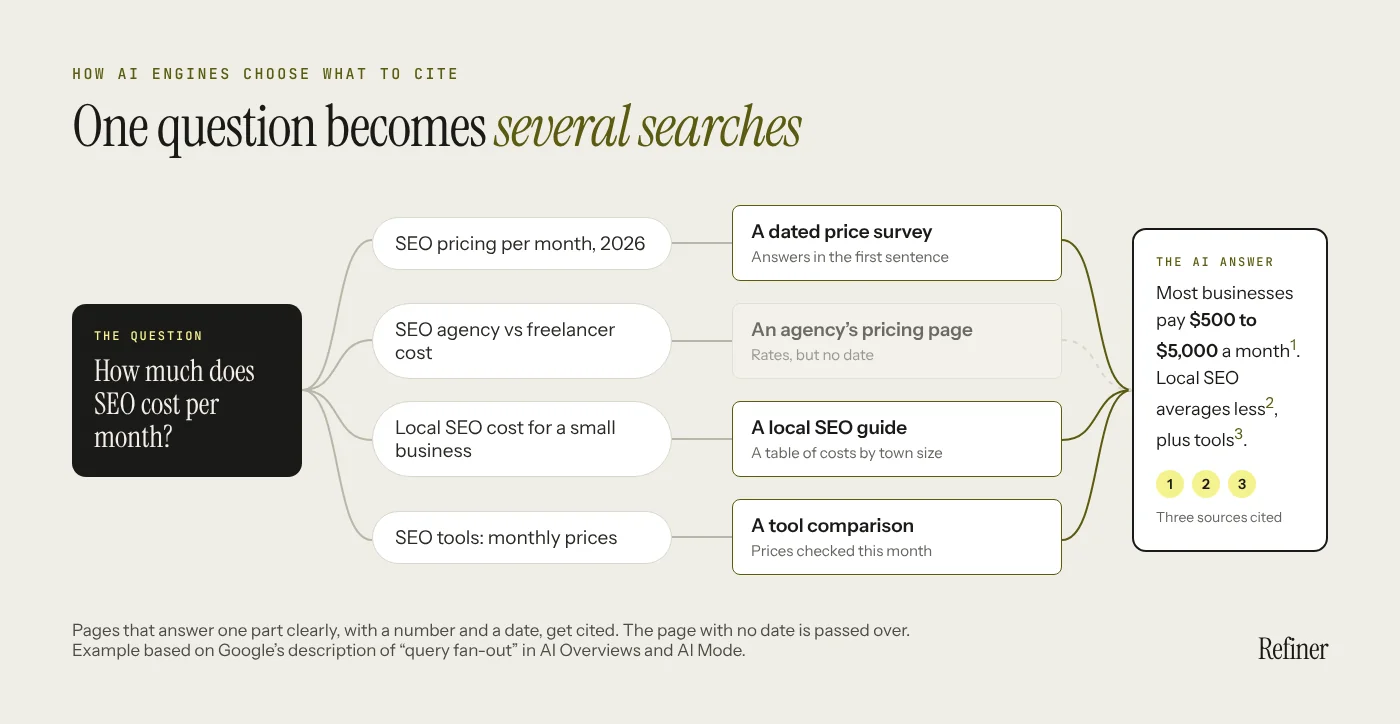
AI answer engines don't simply search once for your question. Google says AI Overviews and AI Mode may use a "query fan-out" technique: they run several related searches across subtopics, gather the results, then write one answer that draws on the clearest passages. ChatGPT, Perplexity and others work in a similar way.
This has two consequences. A page can be cited for a sub-question it answers well, not just its main topic. And because these engines draw on search indexes, ordinary SEO is still the foundation: a page that isn't indexed can't be cited.
That second step is where GEO happens. The original GEO study from Princeton and other universities (published at KDD 2024) tested how rewriting a page changed its visibility in AI answers. The changes that worked best were:
- 01Adding statistics: replacing vague statements with specific numbers.
- 02Citing sources: linking to where each claim comes from.
- 03Adding quotations from credible people.
The best of the methods tested raised visibility by up to 40%, while keyword stuffing, the old SEO habit, did not help. A 2026 survey of GEO research notes that those gains hold within the study's test setup, where the source was already among the pages the engine was given, so they aren't a promise for every page. Even so, the direction is consistent: specific, sourced, quotable writing gets used.
AI engines quote passages, not pages. Specific numbers, named sources and a date are what get a passage lifted into the answer.
Writing answers that AI engines quote
AI engines quote passages, not whole pages, so every section has to make sense on its own. This structure works for almost any question:
- 01The question as the title. Use the words people actually type, such as "How Much Does SEO Cost Per Month?"
- 02The answer in the first two sentences. Include a number, who it applies to and the main thing that changes it. No warm-up paragraph.
- 03A "last checked" date near the top, so readers and engines can see the answer is current.
- 04A table of the details: a price breakdown, a comparison grid or a list of limits. Each row can be quoted as its own answer.
- 05What changes the answer: the three to six factors that move the figure up or down.
- 06An FAQ of follow-up questions, taken from Google's "People also ask" box and from asking AI assistants yourself. Answer each in one or two sentences.
- 07Sources for every figure, linked.
Two habits matter most. Lead with the answer, because the first clear statement on a page is the one most likely to be lifted. Give numbers, not adjectives: "$1,349 a month" gets quoted, "affordable" doesn't.
The technical side
The best answer in the world can't be cited if AI crawlers can't reach or read it.
1. Get indexed first. To appear as a link in Google's AI Overviews or AI Mode, a page must be indexed and eligible to show a snippet in normal Search. There's no separate AI index to submit to. Check indexing in Google Search Console and Bing Webmaster Tools, since several AI assistants also draw on search engines other than Google.
2. Know which bots do what. Each AI company runs separate bots for training models and for finding pages to cite. Blocking a training bot doesn't stop you being cited; blocking a search bot does.
| Company | Finds pages to cite | Collects training data | Fetches a page when a user asks |
|---|---|---|---|
| Googlebot (AI Overviews and AI Mode are part of Search) | Google-Extended (a robots.txt setting for Gemini training and grounding, not a crawler) | None | |
| OpenAI | OAI-SearchBot | GPTBot | ChatGPT-User |
| Anthropic | Claude-SearchBot | ClaudeBot | Claude-User |
| Perplexity | PerplexityBot | None | Perplexity-User |
Google-Extended has no effect on Search: Google states it doesn't affect inclusion in Google Search and isn't a ranking signal. Blocking it won't keep you out of AI Overviews, and allowing it won't get you in. To be cited in AI search, make sure the search bots in the first column aren't blocked, by you, your host or a security plugin. Our guide to robots.txt, sitemaps and llms.txt covers the files involved.
3. Know your opt-out options. Google began honouring a Search Console setting that removes your content from AI Overviews, AI Mode and Discover's AI features in June 2026, starting with UK sites and reaching others from July. Before that, the only controls were nosnippet and max-snippet, which also cut your normal search snippets.
4. Put the answer in the HTML. Text loaded by JavaScript after the page opens may be missed, because the crawlers behind most AI assistants don't run JavaScript. Server-rendered or static pages are safest. Our guide to whether Lovable is bad for SEO shows how to check what crawlers receive.
5. Use structured data for clarity, not as a shortcut. Article schema with a dateModified date and author details helps engines understand the page. There's no published evidence that FAQ or other schema gets you cited, so don't expect it to do the work of a good answer.
6. Don't count on llms.txt. An Ahrefs study of 137,000 sites found that 97% of llms.txt files received no requests at all in May 2026, and there's no evidence it gets you cited.
The marketing side
Technical fixes get you seen. What gets you chosen over the ten other pages saying the same thing is having something they don't.
- 01Publish original data. Survey your customers, collect real quotes, or test something and report the results. An AI engine can only get that number from you, so it has to cite you to use it.
- 02Show who's behind the answer. A named author with relevant experience, an About page and an editorial policy all signal that the page is trustworthy.
- 03Keep answers current. Re-check prices, rules and statistics regularly and update the date. Old answers are the easiest to replace.
- 04Build your brand beyond your site. AI engines learn who to trust from what the rest of the web says about you. Mentions in trade press, reviews, and helpful answers on Reddit, YouTube and industry forums often matter more for AI citations than links alone. AI answers frequently cite those platforms directly, so being present there counts twice.
Measuring AI visibility is still rough, but three checks cover most of it:
- 01Track citations by hand or with a tool. Keep a list of 20 to 50 questions your customers ask. Each month, ask them in ChatGPT, Perplexity, Gemini and Google's AI Mode, and note whether you're cited and who is cited instead. Paid tools such as Ahrefs Brand Radar or Semrush's AI visibility tools automate this.
- 02Check AI referrals in analytics, from chatgpt.com, perplexity.ai, gemini.google.com and claude.ai. Treat the numbers as a minimum: many AI visits arrive without a referrer and are counted as direct traffic.
- 03Don't expect Search Console to separate AI traffic. Google counts clicks and impressions from AI Overviews and AI Mode within overall search traffic, so you can't isolate them there. Watch the trend for question-style searches instead.
Staying on the right side of Google
GEO isn't a way around Google's rules. Google's spam policies define spam to include attempts to manipulate generative AI responses in Google Search, as well as regular results.
The biggest risk is what Google calls scaled content abuse: publishing large numbers of pages mainly to rank, with little value for readers. That applies whether pages are written by people or by AI. Templates are fine for structure, but every page needs something of its own, such as real figures, sources or first-hand experience. Google's own guidance is that using AI is fine; using it to mass-produce low-value pages is not.
Two recent updates to know about:
- 01November 2026 core update: ran from 10 to 24 November. Google called it a regular update and gave no new specific guidance.
- 02December 2026 core update: announced in advance on 24 November. Google says it aims to better understand and rank content for longer, more complex queries, and to improve personalised results. That's good news for anyone answering real questions in the words people use to ask them.
If your traffic moves during an update, wait until the rollout finishes (usually about two weeks) before changing anything. Our summary of the November and December 2026 core updates covers what to check, and how to prepare for December.
Test it yourself: a simple citation experiment
The most useful GEO data is your own. This test takes about two hours a month.
- 01Pick 20 questions from your niche, mixing question types (cost, comparison, how long, how to).
- 02Ask each one in ChatGPT, Perplexity, Gemini and Google's AI Mode, using a logged-out or fresh session.
- 03Record every cited source in a sheet: the site, the type of page (guide, forum, video, news, brand site) and whether it answered in its first sentence.
- 04Repeat after you publish or rewrite pages, and compare.
If you'd like help choosing the questions or rewriting the answers, our AI SEO work starts with exactly this test.
Sources
- 01Google Search Central: AI features and your website
- 02Google Search Central: Spam policies for Google web search
- 03Aggarwal et al., GEO: Generative Engine Optimization (KDD 2024)
- 04Optimizing Visibility in Generative Engines: A Critical Survey of GEO (2026)
- 05Anthropic: how Anthropic's bots crawl the web, and how to block them
- 06Ahrefs: 97% of llms.txt files never get read
- 07Search Engine Journal: Google-Extended is not an AI Overviews opt-out
- 08Search Engine Journal: What opting out of Google's AI search features means now
- 09Google Search Status Dashboard: November 2026 core update
- 10Google Search Status Dashboard: December 2026 core update
What's the difference between SEO and GEO?
SEO aims to rank pages in search results. GEO aims to get your content quoted in AI-written answers. They overlap heavily: AI engines rely on search indexes, so good SEO is the starting point for GEO.
Do I need to allow GPTBot to appear in ChatGPT answers?
No. GPTBot collects training data. ChatGPT search uses OAI-SearchBot, so that's the one that must not be blocked.
Does blocking Google-Extended remove me from AI Overviews?
No. AI Overviews and AI Mode are part of Google Search. To leave them, use the AI features setting in Search Console, or the nosnippet directive, which also removes your normal snippets.
Is AI-written content bad for GEO?
Not in itself. Google's problem is with mass-produced pages that add little value. AI-assisted content that is fact-checked, sourced and adds something original is fine.
How long does GEO take to work?
Pages already indexed and ranking can start being cited within weeks of an update. New sites need to be indexed and build some authority first, which usually takes months.
Can I pay to appear in AI answers?
Not in the organic answers. Some AI products are starting to show ads, but these are labelled and separate from cited sources.
“GEO comes down to one idea: find the questions people actually ask, then answer them so clearly that AI assistants quote you as the source.”
Copy post gives you the takeaway and the link, ready to paste into LinkedIn.Lawford, A. (25 November 2026). Generative Engine Optimization (GEO) in 2026: Answering What People Actually Look For. Refiner Agency. https://refineragency.com/insights/generative-engine-optimization-2026