
B2B buyers no longer search in keywords. They describe their situation in a full sentence and ask who can help, the way they would ask a colleague or an AI assistant. Google's December 2026 core update, announced on 24 November, is Google catching up: it is built to understand and rank content for longer, more complex questions.
Our own Search Console shows how far the shift has gone. Over the last 28 days, 43% of the different searches that showed our site in Google were eight words or longer, and those long searches put us at an average position of 5, against 36 for searches of three or four words. The rest of this article sets out what happened in November, what December changes, and what B2B marketers should do about it.
In this article · 12 sections
- 01The November update, in brief
- 02What our own data shows
- 03What December is built for
- 04How B2B buyers search now
- 05The anatomy of a long question
- 06Personalisation makes rank trackers less reliable
- 07What to do now
- 08When did the November 2026 core update finish?
- 09Has the December 2026 core update started?
- 10What does the December 2026 core update target?
- 11How long do Google core updates take?
- 12Should I change my website because of the November update?
The November update, in brief
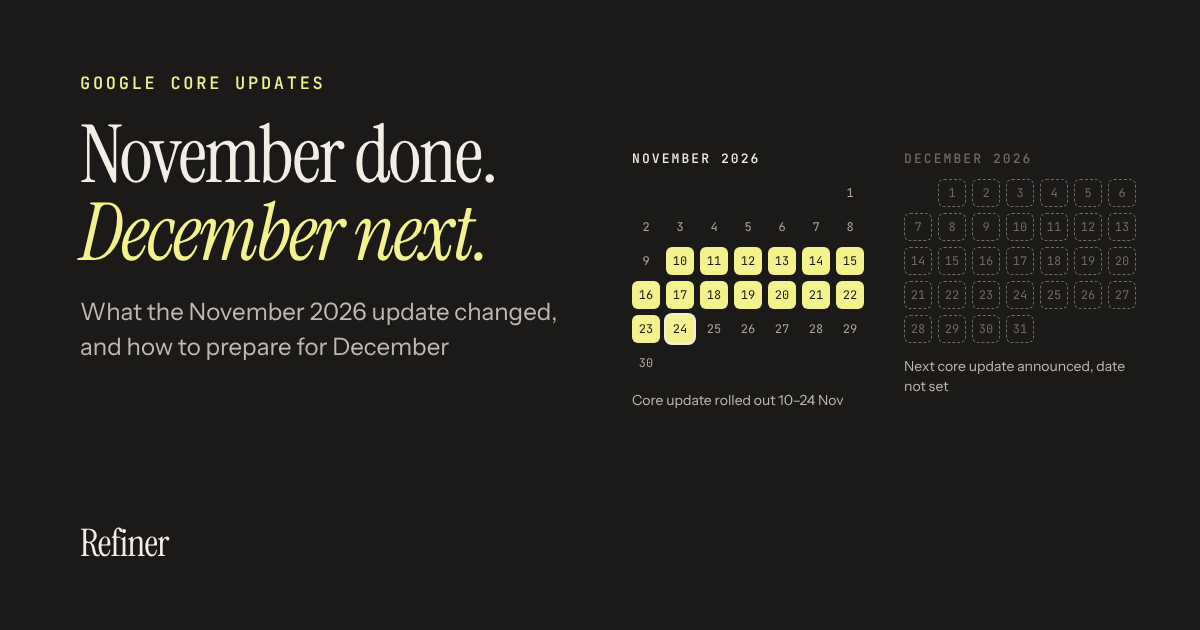
Google's November 2026 core update ran from 10 to 24 November, almost 14 days. It was the third broad core update of 2026, and the longest of the three. Google said it applied worldwide and in all languages, called it a regular update, and gave no new guidance about what it changed.
| Update | Started | Finished | How long |
|---|---|---|---|
| March 2026 core update | 27 March | 8 April | 12 days, 4 hours |
| May 2026 core update | 21 May | 2 June | 11 days, 21 hours |
| November 2026 core update | 10 November, 10:06 Pacific time | 24 November, 06:03 Pacific time | 13 days, 19 hours, 57 minutes |
| December 2026 core update | Announced in advance on 24 November | Not started yet | Due in December |
The full record is on Google's Search Status Dashboard, and Search Engine Journal has a summary of the rollout.
What our own data shows
We compared our Search Console figures for the two weeks of the rollout with the two weeks before it started:
| Measure | Rollout fortnight vs the fortnight before |
|---|---|
| Impressions | Up 131% |
| Clicks | Up 283%, from a small base |
| Click-through rate | Up 66% |
| Average position | Up 12 places, from 32 to 20 |
One honest caveat: we also moved our website to a new platform and published new guides during those same weeks, so we can't say how much of this was the update and how much was our own work. What the data does show clearly is *which* searches we win, and that is where the December update comes in.
What December is built for
Google's announcement says the December update brings several improvements to how its systems understand and rank relevant content. It names two aims:
- 01Longer, more complex questions. Better ranking for searches written as full questions.
- 02Personalised results. Better results for people who have personalisation turned on.
It will apply in every location and language where Google Search is available, and Google hasn't given a start date beyond "December".
Announcing a core update in advance is itself unusual. Google normally announces one once it has started. Last December, Google's John Mueller explained why: Google launches quality changes when they are ready and tested, so having them ready for a set date is never a given. Google hasn't said why it gave notice this time.
How B2B buyers search now
Here is how the searches that found our site in the last 28 days break down by length:
| Search length | Share of searches | Share of impressions | Our average position |
|---|---|---|---|
| 1 to 2 words | 7% | 6% | 33 |
| 3 to 4 words | 31% | 60% | 36 |
| 5 to 7 words | 18% | 11% | 24 |
| 8 words or more | 43% | 22% | 5 |
Short searches still bring the most impressions, but we rank on page three or four for them, competing with every agency in the country. Long searches are where we appear in the top five. More than one in five of the searches that found us were written as a question, starting with words like "which", "how" or "who". The average search in the list was nine words long.
Some are much longer. These are real searches that showed our pages in Google:
- 01which agencies are best for corporate website redesign projects?
- 02which agency should we hire for a b2b rebrand and website redesign at the same time?
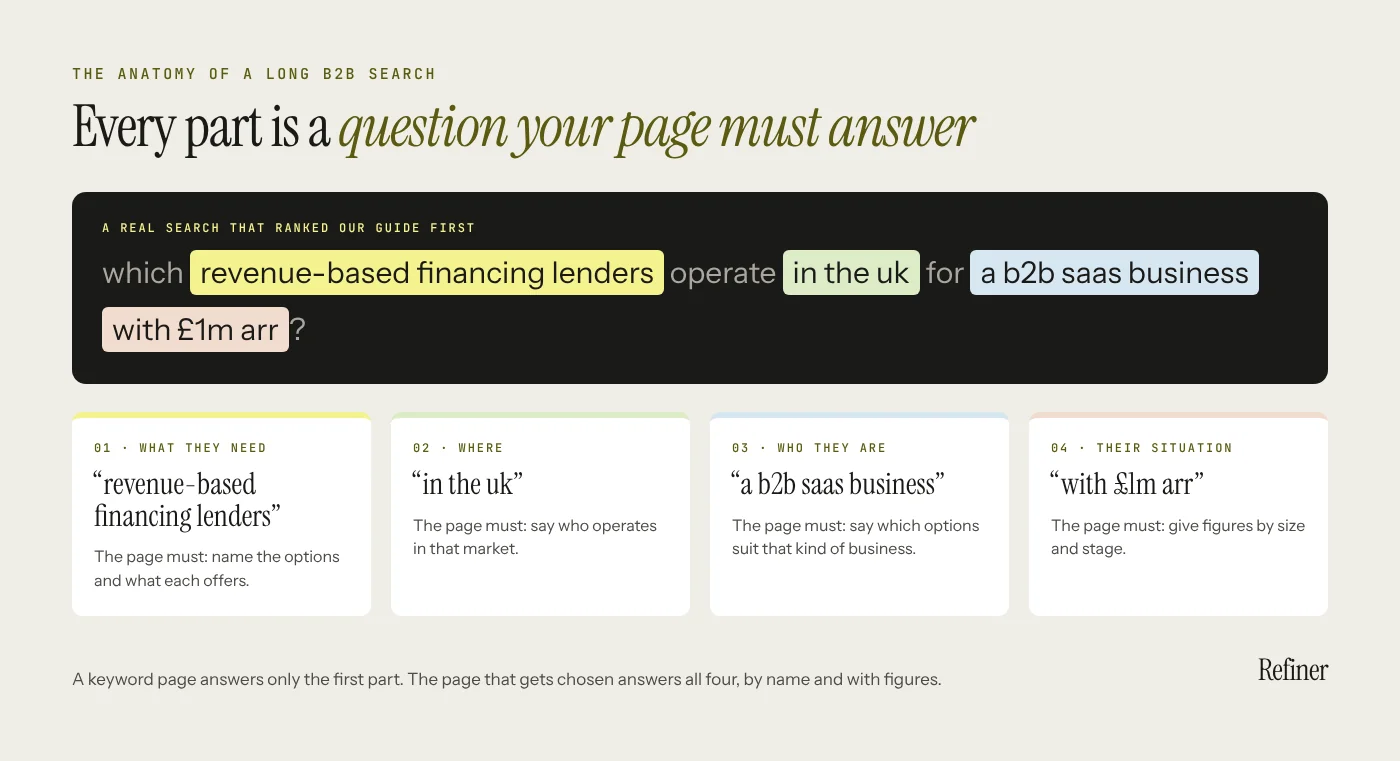
- 03which revenue-based financing lenders operate in the uk for a b2b saas business with £1m arr?
- 04which revenue-based financing lenders operate in the uk for a saas company growing 50% a year?
- 05i am a new cmo and the website i inherited does not represent where the company is going. which digital agency should i hire to rebuild it?
- 06our website revamp needs to happen without any downtime or seo loss since we get significant organic traffic. which agencies have a proven migration process for high-traffic b2b sites?
Some of these read exactly like prompts typed into an AI assistant. Whether a person typed them into Google or an assistant searched on someone's behalf, we can't tell. Either way, they are the questions buyers are asking.
43% of the searches that found us last month were eight words or longer, and we ranked in the top five for them. For short keywords, we sit on page three.
The anatomy of a long question
Almost every long B2B search is built from the same four parts:
- 01What they need: the product or service, in their words, not yours.
- 02Where: the country or region they buy in.
- 03Who they are: their kind of business and their role, such as "a new CMO".
- 04Their situation: size, growth, a deadline or a constraint, such as "without any downtime or seo loss".
A keyword page answers only the first part. A page that wins these searches answers all four: it names options, says who each suits by size and stage, and gives figures. Our comparison of UK revenue based finance lenders does this, and it ranks first in Google for the lender questions above, and for others about edtech, fintech and bootstrapped SaaS businesses. Our guide to choosing a website redesign agency does the same for agency questions.
Personalisation makes rank trackers less reliable
December's second aim matters as much for measurement as for ranking. If Google personalises results more, the same search returns different results for different people. A rank-tracking tool checks one version of the results, from one location, without anyone's search history, so it will show you a position few real buyers see.
Search Console doesn't have that problem. It reports where your pages actually appeared for real people, averaged across every time they were shown. After December, treat it as your main source of truth, and treat third-party rank positions as a rough guide.
Long searches make the point too. A rank tracker only follows the searches you give it, and no two buyers write a 30-word question the same way. The only place to see them is Search Console's queries report.
What to do now
Wait before you judge November. Google's advice is to wait at least one full week after an update finishes before reviewing your numbers. For November, that means 1 December at the earliest. Then compare a full week after the rollout with a full week before it started, such as 3 to 9 November, and check average position as well as clicks. A fall in clicks with a steady position is demand, not the update.
Allow for the season. Black Friday and Cyber Monday fall in the first week after the rollout, and the weeks around Christmas are quiet for most B2B buyers. Compare like with like, and expect December's numbers to be distorted whatever the update does.
Record a baseline before December starts. Two core updates weeks apart make it hard to tell which one caused a change. Save a week of clicks, impressions and average position for your most important pages now.
Hold off on big changes. Rewriting many pages, changing addresses or moving platform while an update is pending makes it impossible to separate your changes from Google's. If you're planning a migration, wait until the December rollout has finished. Our guide to migration redirects covers what to plan meanwhile.
Write for the whole question. Open your Search Console queries report, filter for searches of eight words or more, and read them. They tell you, in your buyers' own words, which situations your pages need to answer. Our guide to generative engine optimisation in 2026 covers how to turn them into answers that both Google and AI assistants quote.
Expect some of Search Console to lag: its Page indexing report has run weeks behind several times this year, so use the Performance report and URL Inspection for current figures.
If you'd like us to run this analysis on your own Search Console, book a refinement consultation. Our organic SEO work starts with exactly this.
When did the November 2026 core update finish?
On 24 November 2026 at 06:03 Pacific time, according to Google's Search Status Dashboard. It started on 10 November and took 13 days, 19 hours and 57 minutes.
Has the December 2026 core update started?
Not as of 25 November 2026. Google announced it in advance on 24 November and said it's due in December. Check Google's Search Status Dashboard, which shows when an update starts and finishes.
What does the December 2026 core update target?
Google says it improves how its systems understand and rank content for longer, more complex questions, and improves personalised results for people who have personalisation turned on.
How long do Google core updates take?
Usually around two weeks. In 2026, the March update took just over 12 days, May's almost 12 and November's almost 14.
Should I change my website because of the November update?
Not straight away. Wait a full week after the update, compare your numbers fairly, and change what the data shows is weak. With the December update pending, record a baseline first and make big changes after it finishes.
“43% of the searches that found our site last month were eight words or longer, and they ranked near the top. Google's December 2026 update is built for exactly these questions.”
Copy post gives you the takeaway and the link, ready to paste into LinkedIn.Lawford, A. (25 November 2026). Google's November and December 2026 Core Updates: What Our Search Data Shows. Refiner Agency. https://refineragency.com/insights/google-core-update-november-december-2026