Refiner Client sign inSign in Book a call
Book a call
SEO website migration

SEO website migration

SEO website migration for B2B companies changing platform, domain or design. We map every old address, test every redirect before launch and watch Search Console afterwards, so the traffic and leads you've built move with you.

Moved from Lovable to Claude Code on our own site
86 pages
From start to launch
1 week
Redirect rules tested before and after launch
111
Why it matters

Search engines rank addresses, not designs. When an address changes without a redirect, its rankings and the links pointing at it stop counting, and anyone following an old link lands on a 404. Google says permanent redirects don't lose PageRank, so the losses come from addresses that were missed, sent to the wrong page or sent to the homepage.

The risks are the same whether you're changing platform, domain, design or URL structure: missing redirects, pages left out of the new site, content cut in the redesign, a leftover noindex tag, and a new site that crawlers can't read. Each one is avoidable with a plan made before the build starts.
Sound familiar? Here's what we do.

Four situations behind most migration enquiries, and what we do about each one.

A redesign or new platform could wipe out our rankings

Organic search brings in a share of our leads, and the new site changes most of our addresses.

Mapping every old address

We build the full list of old addresses from your sitemap, analytics, Search Console and its links report, including PDFs and images that earn links. Each one gets a destination: its closest new page, or a 404 or 410 if the content is gone for good. Nothing is sent to the homepage in bulk.

Each redirect goes to its final page in one hop, as a permanent server redirect. Internal links, canonical tags and the sitemap are updated to the new addresses, so your own pages don't send search engines through redirects.

Plan my migration

Our developers say redirects are handled, but nobody has checked

There's a redirect file, but no one has tested it against every old address, image and PDF.

Testing before launch

Before the switch, we test every redirect rule against the new site and crawl it the way a search engine does. We check that the SEO work on the old site has carried over and that nothing is blocking the new one:

  • Every old address redirects to the right new page
  • No broken internal links
  • No leftover noindex tags or robots.txt blocks
  • Titles and descriptions on every template
  • Structured data still valid
  • Content in the HTML, readable without JavaScript
Check our redirects

We've already launched, and traffic has dropped

Search Console shows new 404s and pages falling out of the index since the move.

Launch, then watch

After launch we submit the new sitemap, check Search Console for new 404s and indexing errors, and fix them as they appear. Google says most pages on a small to medium site take a few weeks or more to move in its index, and rankings can fluctuate meanwhile, so we compare traffic and enquiries with the weeks before the move rather than day to day.

The redirects stay in place for the long term; Google recommends at least a year. Our post-migration checklist covers the fixes we made on our own site after launch.

Help after launch

We're moving off Lovable or another AI site builder

The old site was built in the browser. We want the new one to be readable by search engines and AI crawlers.

Replatforming, redesigns and moves off Lovable

The same method applies to a WordPress rebuild, a move to a headless CMS, a domain change or a redesign that changes the site's structure. If you're moving off Lovable or another tool that builds pages in the browser, the move is also the moment to fix what crawlers see. Our Lovable to Claude Code migration guide sets out how we did ours, and our guide to planning and testing redirects covers the mapping in detail.

If the move is part of a redesign, we work alongside your designers or agency from the first sitemap, so SEO decisions are made before pages are designed rather than after.

Plan a move off Lovable

Planning a move? Get the risks mapped first.

On a free 30-minute call, we'll look at your current site and plan, and tell you which pages and addresses carry the most search value.

Four steps, from sitemap to launch.

SEO joins the project before anything is designed, and stays after launch until the new addresses have settled in Google's index.

  1. Before design

    Map

    We list every old address from your sitemap, analytics and Search Console, and agree where each one goes.

  2. During the build

    Brief

    SEO requirements for every template: titles, headings, structured data, internal links and content in the HTML.

  3. Before launch

    Test

    We crawl the new site the way a search engine does and test every redirect rule before the switch.

  4. After launch

    Watch

    New sitemap submitted, Search Console checked for 404s and indexing errors, and fixes made as they appear.

Start with a call

The first 30-minute call is free. £400$540€470 a day, for one-off projects. See pricing

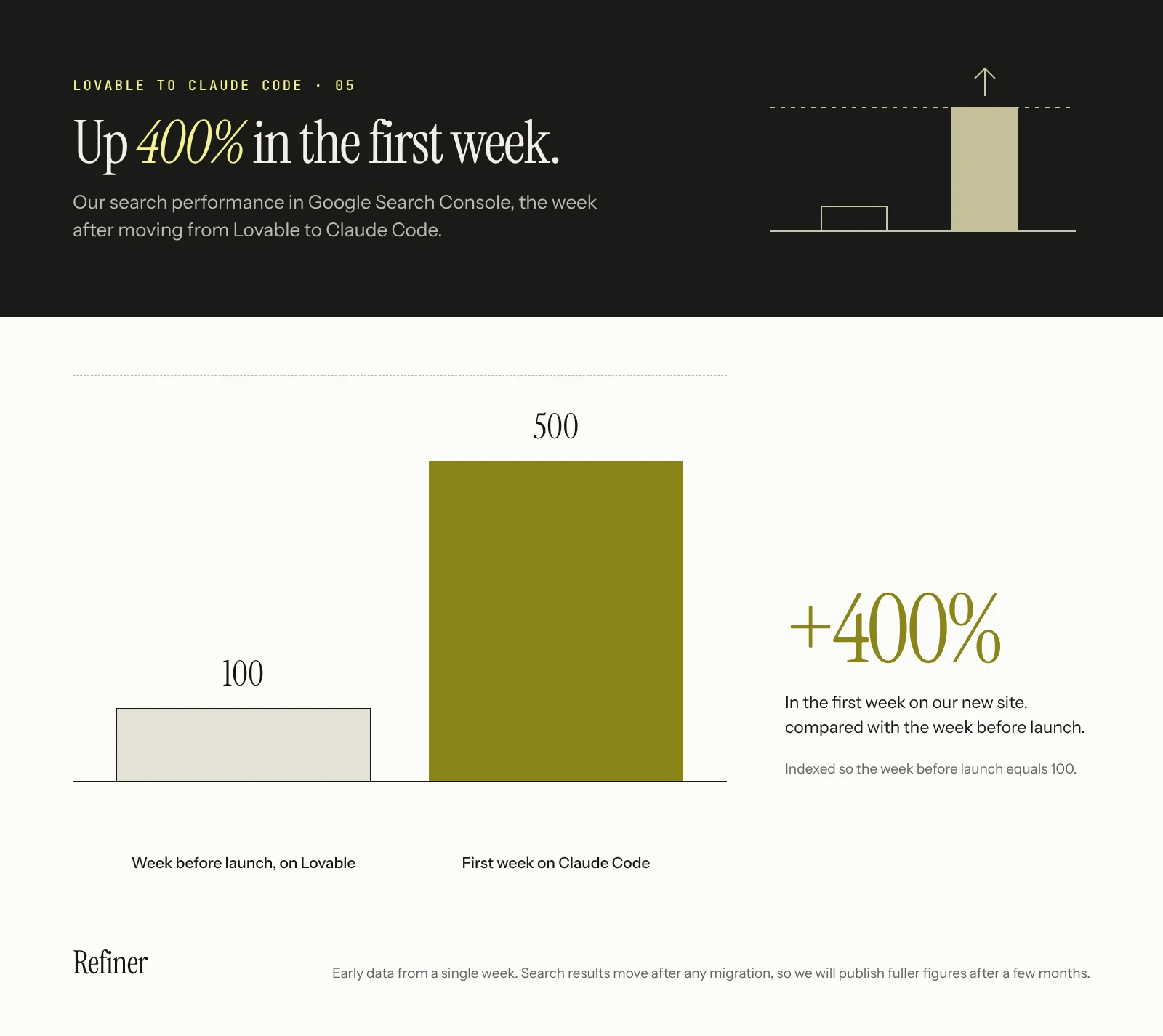
+400%Search performance in Google Search Console, first week after launch

We moved our own 86-page website from Lovable to Claude Code in a week, redirected every old address and tested all 111 redirect rules. In the first week on the new site, search performance in Search Console was up 400% on the week before.

Bar chart of Refiner's Google Search Console search performance, indexed to 100 for the week before launch on Lovable and 500 for the first week on Claude Code, an increase of 400%

Deliverables, not decks.

Book a call
  • Inventory of every old address, from sitemap, analytics and Search Console
  • Redirect map with a destination for every address
  • SEO requirements for the new site's templates
  • Pre-launch crawl and a test of every redirect rule
  • Launch-day checks and sitemap submission
  • Post-launch monitoring of 404s, indexing and traffic
  • A before-and-after report on traffic and enquiries

Questions we hear most.

Ask us directly
Q1What does an SEO website migration service include?

An SEO website migration service from Refiner includes a full list of your old addresses, a redirect map, testing of every redirect before launch and monitoring after it. We also check that titles, descriptions, structured data and internal links carry over, and that crawlers can read the new pages. Your proposal sets out exactly what's covered for your site.

Q2When should SEO be involved in a website migration?

SEO should be involved in a website migration before the new site is designed, not in the final week. The sitemap, the URL structure and which pages are kept or cut all decide which rankings survive the move. Bringing SEO in early costs far less than recovering lost traffic after launch.

Q3Can Refiner migrate a website off Lovable without losing SEO?

Yes. Refiner moved its own 86-page website from Lovable to Claude Code in a week and redirected every old address. In the first week after launch, our search performance in Google Search Console was up 400% on the week before. We can plan the same move for your site, or tell you if an upgrade inside Lovable is enough.

Q4How much does an SEO website migration cost?

An SEO website migration from Refiner is priced by the day: £400 a day, our rate for one-off projects. The number of days depends mainly on how many pages and old addresses your site has. The first 30-minute call is free, and if there's a genuine fit, your proposal sets out the days involved, so you know the cost before anything starts.

Let's talk SEO website migration

Answer four quick questions and book a 30-minute call. We read your brief before we talk, and follow up with a written plan if there's a genuine fit.

  1. 01Which of your pages carry the most search value
  2. 02The redirect and platform risks in your plan
  3. 03What to check in the weeks after launch

Not ready for a call? Answer three questions and Alex will email you a view.