
Most businesses want the same three things: a steady flow of qualified leads, a low cost to win them and a high value per client. It sounds like too much to ask, but it is what a well-built SEO programme delivers. FieldworkHub's organic leads grew from 2 to 50 a month over two years, and that pipeline doesn't stop the day an ad budget runs out.
AI search is changing who can do this. Small, focused teams can now compete credibly with much larger firms, because AI assistants answer buyers' questions from the clearest, most specific sources, not only the biggest ones. Firms that move first have an unusual chance to claim ground.
In this article
- What a category is, and why owning one matters
- Buyers already research with AI
- How to own your AI SEO category
- The pages that build category ownership
- Why the window is open now
- What is category ownership in AI SEO?
- How is a category different from a vertical?
- Can a small B2B team own a category in AI search?
What a category is, and why owning one matters
A category is a broad market perception, such as "SEO consultant". A vertical is narrower, such as "AI SEO consulting" or "technical SEO for B2B SaaS". Owning a vertical builds depth. Owning a category builds dominance.
Most businesses work across several verticals. For the first time, small teams can realistically aim to own a whole category, and AI SEO is how they get there.
Buyers already research with AI
The AI-shaped buyer journey is already here. In Gartner's 2024 survey of technology buyers, 45% used generative AI to support their purchase decisions, through tools such as ChatGPT.
These buyers don't just search. They ask follow-up questions, compare suppliers and look for clear recommendations. Content that answers those questions in depth becomes a lasting advantage.
How to own your AI SEO category
Ownership starts with a clear choice and steady execution.
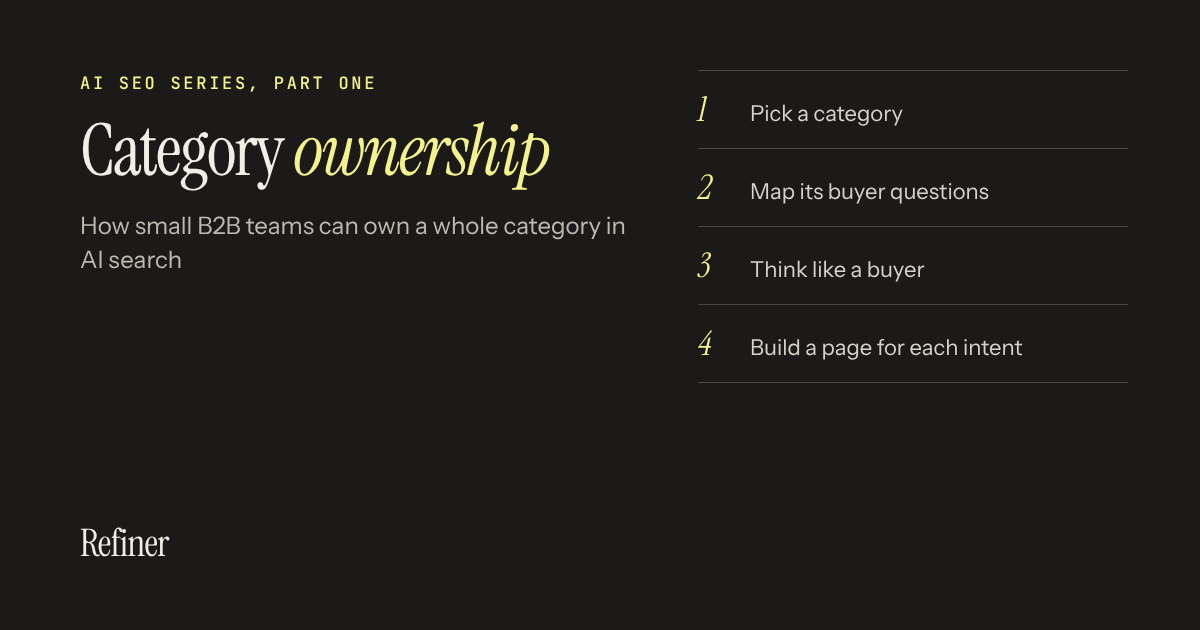
- Pick a category. Choose one that matches your long-term strengths, such as "AI SEO consultant", then build out the verticals beneath it.
- Map the questions in it. Use a tool such as AnswerThePublic, your Search Console queries and your sales calls to find the what, where, why and how questions buyers ask. The aim is to make your firm the answer to "who".
- Think like a buyer. Buyers haven't changed; their tools have. They still want proof, specifics and a firm they can trust.
The pages that build category ownership
Your sitemap should be a map of buyer intent:
- Location pages: where you work, with the local market or regulatory conditions that matter there.
- Industry pages: your expertise by sector, showing you understand each sector's problems.
- Service and capability pages: what you do, explained clearly, one service per page.
- A technical blog: depth on the topics buyers research, with diagrams, sources and worked examples.
- A knowledge base: answers people can find and share without contacting you.
This structure mirrors how buyers think, and it helps search engines and AI assistants understand what you're relevant for. The more specific and consistent your site, the more likely it is to be the source an AI answer draws on.
Why the window is open now
AI search is still settling. Google released three core updates in 2026 before December's, AI assistants keep changing how they choose sources, and buyers expect more depth from what they read. Many established firms still rely on what worked years ago: volume of content, link building and keyword repetition.
That leaves categories open to whoever builds the clearest, most useful body of answers first. Pick your category, map its questions and start building.
This is part one of a two-part series. Part two, structuring content for AI SEO, covers how to write the pages themselves.
What is category ownership in AI SEO?
Category ownership in AI SEO means becoming the source that search engines and AI assistants turn to for a whole market category, such as "SEO consultant", rather than one narrow niche. It comes from answering the questions buyers ask across that category, with a page for each service, industry and location you serve.
How is a category different from a vertical?
A category is a broad market perception, such as "SEO consultant", while a vertical is a narrower specialism within it, such as "technical SEO for B2B SaaS". Owning a vertical builds depth in one area. Owning a category means buyers, search engines and AI assistants associate your firm with the whole market.
Can a small B2B team own a category in AI search?
Yes. A small B2B team can own a category in AI search, because AI assistants draw on the clearest, most specific answers rather than only the biggest brands. Kord's search results rose 500% in six months after Refiner rewrote its website for AI search. Consistent coverage of buyer questions matters more than team size.
“AI search has opened a window for small B2B teams to own a whole category. Pick one, map the questions buyers ask in it, and build a page for every service, sector and location you serve.”
Copy post gives you the takeaway and the link, ready to paste into LinkedIn.Lawford, A. (26 November 2026). Category ownership for AI SEO: a short guide. Refiner Agency. https://refineragency.com/insights/ai-seo-category-ownership