
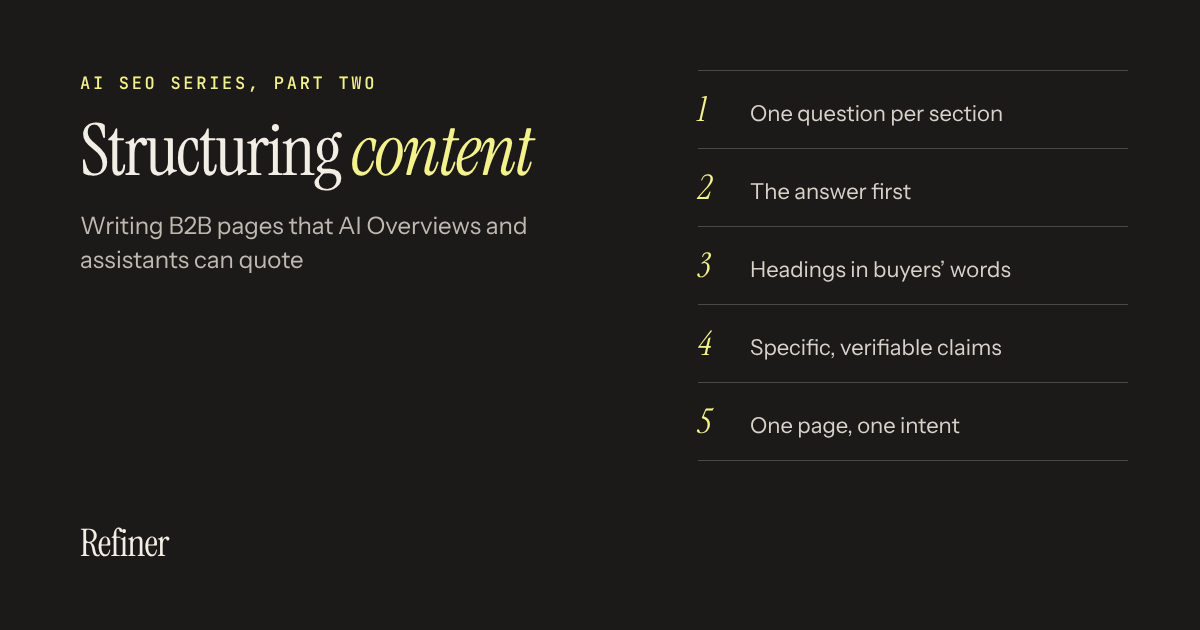
Over the past two years, AI search has grown from the occasional featured snippet into full AI Overviews and AI assistant answers. At first it lifted half a sentence from a product page or a how-to post. Now it often condenses a whole search session into a few generated paragraphs, and more buyers start their research in ChatGPT, Claude or Google's AI Mode.
That changes the goal. Position one still matters, but the bigger prize is being the source the answer draws on. Google says there's no special format for its AI features: what works is clear, specific, accurate content that people find useful. In practice, that rewards pages with a disciplined structure, and that is what this guide covers.
In this article
- AI Overviews changed search gradually, then quickly
- Write key answers as self-contained blocks
- Structure first, then style
- AI shortlists are the new top ten
- How to get cited in AI answers
- AI search is literal, so be explicit
- Location, sector and intent
- Use AI Overviews as a blueprint
- One page, one intent
- Speak the language, don't game it
- How should content be structured for AI SEO?
- How long should a paragraph be for AI Overviews?
- Does keyword stuffing help AI SEO?
AI Overviews changed search gradually, then quickly
Search has always evolved, but rarely this fast. Google's AI Overviews and AI Mode don't just summarise a page; they extract from it, combine it with other sources and sometimes link back. Pages that answer clearly and specifically are easier to use as a source than pages that make the reader dig.
Look at which pages AI tools cite and a pattern appears. They tend to favour content that states its answer plainly, under a heading that says what the section covers.
Write key answers as self-contained blocks
The discipline I use with clients is to write key answers in blocks of roughly 320 to 420 characters, two or three sentences. That isn't a Google rule, and no paragraph needs to hit a number. It's a way of training a team to write in units of value: each block answers one question, carries one main term and makes sense on its own.
A block that size is long enough to hold a complete answer and short enough to quote whole. It suits readers who scan as well as the AI assistants that summarise.
Structure first, then style
Good AI SEO content is part editorial, part engineering. A page that reads like a mind map pasted into a CMS is hard for anyone to use. A page made of clearly labelled sections, each answering one question in plain language, works for people and machines alike.
Under each heading, answer one question, match one search intent and stay on that topic.
Focus each paragraph on one idea
Each paragraph should cover one idea or a closely related group of terms. One clear point per block makes the page easier for readers to scan, and easier for search engines and AI assistants to understand.
Write headings that say what follows
Headings are signposts, not poetry. Write headings that tell the reader exactly what's next, in the words a buyer would use. A clear H2 beats a clever one when visibility in AI search is the goal.
Cut the filler
Strip out jargon and sentences that say nothing. Write like someone who respects the reader's time and knows the subject. One clear idea per paragraph, stated with confidence.
Keep sections in proportion
A 100-word section followed by a 500-word wall is hard to follow. Keeping key sections to a similar length gives the page a rhythm readers can scan, and makes each section easier to quote on its own.
Write for people first
Keyword stuffing makes content unreadable, and Google's spam policies treat it as manipulation. Write as an informed person would speak. If a phrase feels forced, remove it.
AI shortlists are the new top ten
Ask ChatGPT for "the best consulting firms in London" or "content writers for B2B SaaS" and you get a shortlist, not a page of links. Those lists draw on sources that state clearly who does what, where and for whom.
To be included, your pages need specific, verifiable claims. "We help clients grow with innovative solutions" gives an AI assistant nothing to repeat. "We run SEO and AI search for B2B fintech firms, and Kord's search results rose 500% in six months" does.
How to get cited in AI answers
There's no single trick, but the pattern holds across sectors: clarity, brevity and plain use of the terms buyers search for. If a heading says "AI strategy consultants", the paragraph beneath it should define who they are, what they do and why it matters.
Put the answer first. Answer engines take the first clear answer, not the one buried four paragraphs down, so lead with your best material.
If you want to be named as a B2B lead generation agency in Germany, say exactly that, then give the evidence that you qualify. Read the page aloud: if it sounds like a clear spoken answer, it's well placed to be used in one.
AI search is literal, so be explicit
Traditional SEO left room to imply and let Google infer. AI search rewards being explicit. If the page is about supply chain consultants in Europe, say so in the H1 and in the opening paragraph, then build the page around location, expertise, sectors and proof.
That can feel mechanical, but personality still has a place. Think of a clean structure with expressive copy on top: logic first, then language.
Location, sector and intent
This applies across SaaS, legal, fintech, consulting, recruitment and more. AI search favours specific combinations like these:
- "[Service] in [location] for [audience]"
- "[Sector] trends in [year]"
- "How to [solve a problem] with [solution]"
These mirror how buyers phrase requests to AI assistants. Write pages that answer them directly, and keep writing well.
Use AI Overviews as a blueprint
Google's AI Overviews show how it breaks a query down: the subtopics it covers, the terms it uses and the facts it highlights. Study them before you write.
If you work across several countries, check how the overview changes by market, for example with a VPN, and note its structure. Then build your page around the questions it covers, answered better than the sources it uses now.
One page, one intent
Long pages that cover ten topics to collect long-tail traffic work less well now. A page that tries to rank for five versions of a service is better split into five pages, each with its own headings, terms and proof. That's how you appear in AI shortlists and answers for each one.
It takes more work, but focused pages are easier to reuse across markets, platforms and sectors.
Speak the language, don't game it
AI isn't replacing SEO; it's reinterpreting it, and it rewards writing that is structured, specific and useful. Build a library of clearly labelled, self-contained answers, keep your voice and bring your expertise to the surface. That serves readers and AI assistants alike.
This is part two of our AI SEO series. Part one covers category ownership for AI SEO, and our AI SEO service puts both into practice.
How should content be structured for AI SEO?
Content for AI SEO should be structured as clearly labelled sections, each answering one question in plain language, with the answer in the first sentence. Google says there's no special format for its AI features, so the aim is clarity: one idea per paragraph, headings in buyers' words and specific, verifiable claims.
How long should a paragraph be for AI Overviews?
There's no required paragraph length for AI Overviews: Google says no special format is needed. Refiner writes key answers in blocks of about 320 to 420 characters, two or three sentences, as an editorial discipline. A block that size holds a complete answer and can be quoted on its own.
Does keyword stuffing help AI SEO?
No. Keyword stuffing doesn't help AI SEO: it makes content harder to read, and Google's spam policies treat it as manipulation. Use the terms buyers search for plainly, in headings and opening sentences, and write the rest as an informed person would speak.
“AI search quotes pages that answer one question at a time, with the answer first and specific claims. Google says there's no special format: clear, accurate writing people find useful is what works.”
Copy post gives you the takeaway and the link, ready to paste into LinkedIn.Lawford, A. (26 November 2026). Structuring content for AI SEO: writing pages AI can quote. Refiner Agency. https://refineragency.com/insights/structuring-content-for-ai-seo