
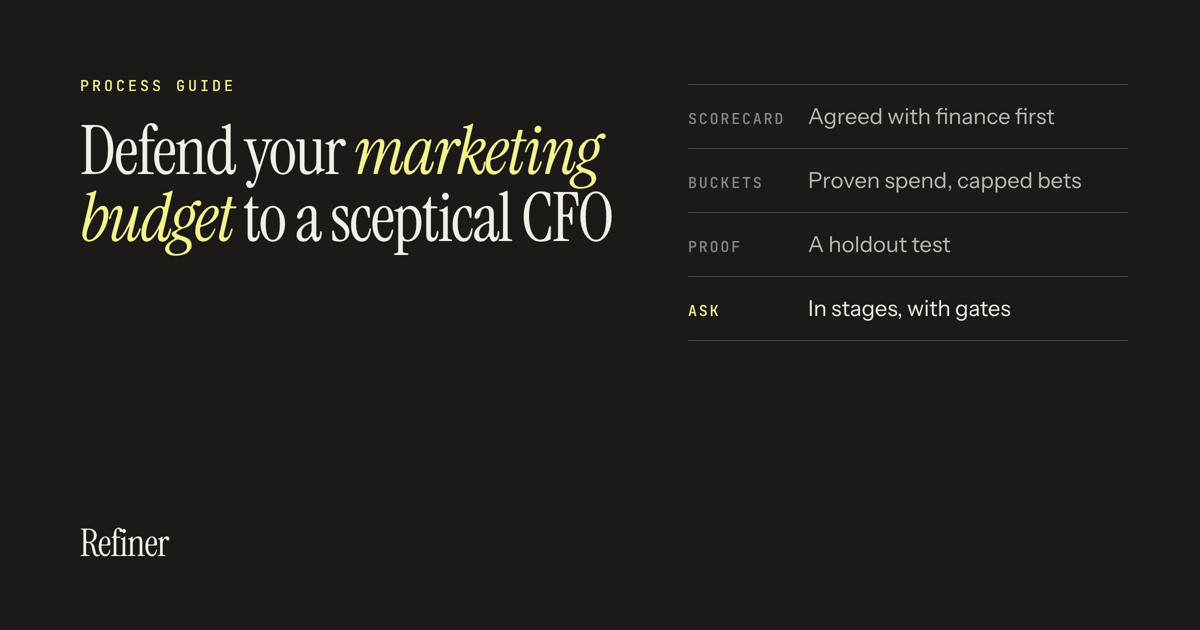
This guide is for CMOs and marketing directors who have to defend a marketing budget to a finance director or CFO who doesn't yet believe the numbers. It covers how to prepare the request, what to put in front of finance, and how to structure the ask so it gets approved.
The pressure is real. Gartner's 2026 CMO Spend Survey found marketing budgets effectively flat, at 7.8% of company revenue in 2026 against 7.7% in 2025. When budgets don't grow, every line gets questioned.
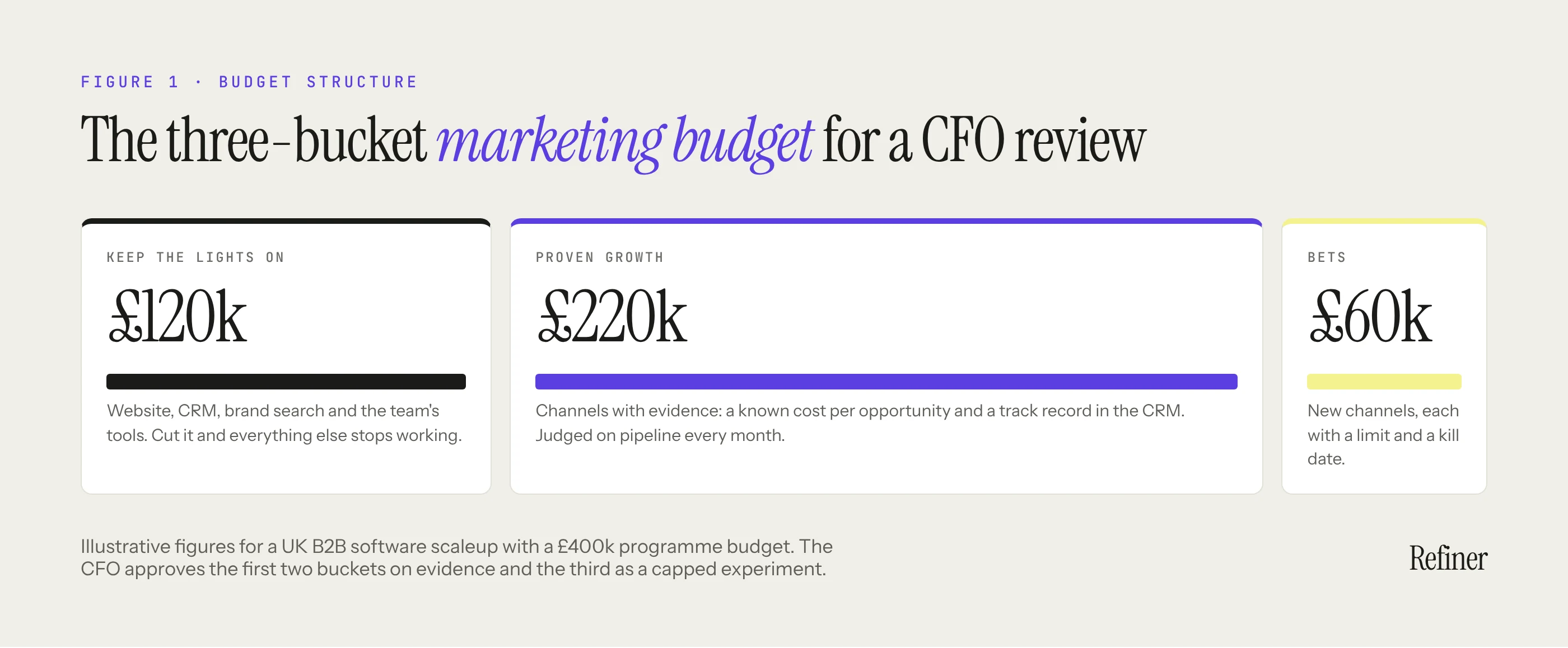
The example used throughout is illustrative: a CMO at a UK B2B software scaleup asking for a £400k marketing programme budget for the year. The figures are made up to show the method; use your own.
In this article
- 1. Understanding what a sceptical CFO needs before approving a marketing budget
- 2. Agree the scorecard before you ask for money
- 3. Split the budget into three buckets
- 4. Show what changes at the margin
- 5. Prove increments with a holdout test
- 6. Ask for the money in stages, with gates
- 7. Model the cost of a cut
- 8. Defending the marketing budget you can't measure
- Marketing budget defence checklist
- How do you justify a marketing budget to a CFO?
- What marketing metrics does a CFO want to see?
- How much do companies spend on marketing as a share of revenue?
1. Understanding what a sceptical CFO needs before approving a marketing budget
A sceptical CFO isn't against marketing. They're against two things: numbers they can't check, and spend they can't stop. Most budget arguments fail because the CMO answers a different question, about how good marketing is, when the CFO is asking how much risk they're taking on.
So treat the CFO as a buyer of an investment, not an approver of a cost. Every step below gives them one of three things: evidence they can check, a way to compare options, or control over the money.
Our example CMO's last request was cut by a third. The CFO's note said the numbers came from ad platforms, not the CRM, and nobody could say what would happen if the budget stopped.
2. Agree the scorecard before you ask for money
Sit down with finance before the budget round and agree how marketing will be judged. Once the CFO has helped set the rules, they can't dismiss the results later.
| Measure | What to agree | Source of truth |
|---|---|---|
| Qualified pipeline | What counts as a qualified opportunity, and who decides | CRM |
| Sourced and influenced | Which deals marketing sourced, which it influenced, and the time window | CRM |
| Cost per opportunity | Spend divided by qualified opportunities, by channel | Finance and CRM |
| Payback period | Months for a customer's gross margin to repay the cost of winning them | Finance |
| Milestones | What "working" means at months 3, 6 and 12 | Agreed in writing |
Use finance's numbers, not marketing's. Ad platform figures, such as return on ad spend and clicks, are useful diagnostics, but if they lead the argument, credibility goes. Our example CMO moved every headline figure into the CRM report the CFO already used.
3. Split the budget into three buckets
One total number invites one total cut. Split the request into three buckets, each judged differently:
- Keep the lights on: the website, CRM, brand search and tools. The cost of being open for business.
- Proven growth: channels with evidence, a known cost per opportunity and a record in the CRM.
- Bets: new channels or ideas, each with a capped amount and a date to stop if it isn't working.
CFOs object to the bets and accept the other two. Showing the split stops one uncertain line from sinking the whole budget.
4. Show what changes at the margin
A CFO decides at the margin: what the next pound buys, and what the last pound loses. "What does the next £50k buy, and what do we lose if we cut £50k?" lands better than an average return across the whole budget.
For each proven channel, show recent cost per opportunity and whether it is rising as spend increases. Our example CMO showed that paid search was close to saturation, so extra money there would buy little, while content and outbound to target accounts still had room. Admitting where returns flatten earns trust for the rest of the request.
5. Prove increments with a holdout test
Attribution models say which channel touched a deal. They don't prove the deal wouldn't have happened anyway. A CFO will believe a controlled test over any model.
Offer one for the largest line. Pause or reduce spend in one region or segment, keep it running in a comparable one, and compare the results. Google Ads supports this as Conversion Lift based on geography, which compares regions that see your ads with regions that don't to measure the increase your campaigns cause. Check that your account can run it before you promise the test to finance.
For B2B, run the test long enough to reach opportunities, not just form fills, and agree the reading with finance before it starts.
6. Ask for the money in stages, with gates
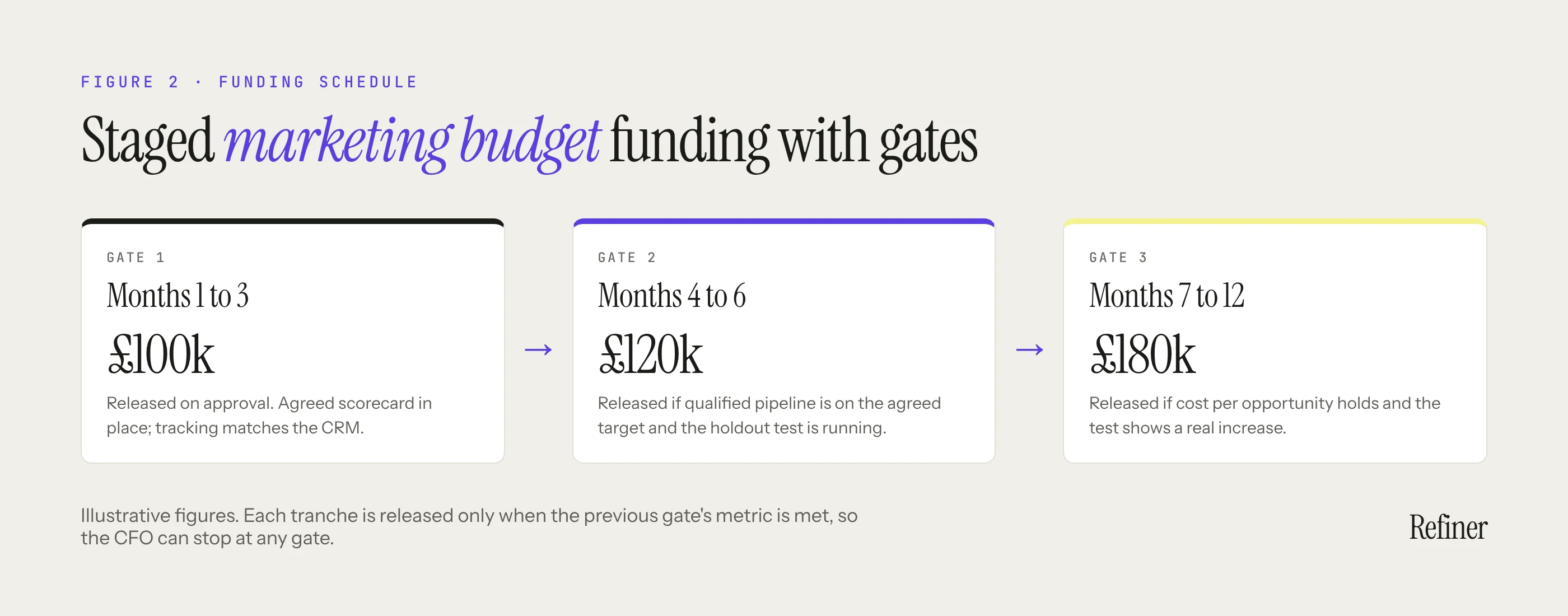
Instead of one annual number, ask for funding to the first milestone, with each further tranche released when the agreed measure is met. That turns a leap of faith into an option the CFO controls.
Our example CMO asked for £100k up front, £120k at month four and £180k at month seven, each gate tied to the scorecard in step 2. The total is the same £400k, but the CFO can stop at any gate.
7. Model the cost of a cut
Cutting marketing looks free in the quarter it happens. On a long B2B sales cycle, the missing pipeline shows up as missed revenue two or three quarters later.
Use your own conversion rates to show it: if a cut removes a set number of qualified opportunities this quarter, how many deals, and how much revenue, go missing later? Present it as a forecast, not a threat, and let finance check the arithmetic.
8. Defending the marketing budget you can't measure
Some marketing doesn't attribute cleanly: brand, events, and sharing in private channels you can't track. Say so up front rather than stretching a model to cover it.
Give that work a small, separately judged budget and a proxy measure the CFO can watch, such as branded search volume, direct traffic or the share of deals where buyers say they already knew you. Then stop arguing about it in every review.
Marketing budget defence checklist
- Agree the scorecard with finance before the budget round
- Report from the CRM and finance systems, not ad platforms
- Split the request into keep the lights on, proven growth and bets
- Show the effect of the next £50k and of a £50k cut
- Offer a holdout test on the largest line
- Ask in stages, with a gate and a measure for each tranche
- Model what a cut does to next year's pipeline
- Give unmeasurable work its own budget and proxy measure
How do you justify a marketing budget to a CFO?
You justify a marketing budget to a CFO by giving them evidence they can check and control over the money. Agree the measures with finance first, report from the CRM rather than ad platforms, separate proven spend from capped experiments, prove increments with a holdout test, and ask for funding in stages that are released when agreed milestones are met.
What marketing metrics does a CFO want to see?
A CFO wants marketing metrics that connect to revenue and can be checked in finance's own systems. The usual set is qualified pipeline, cost per opportunity, customer acquisition cost, payback period and revenue from marketing-sourced deals. Platform figures such as clicks or return on ad spend are diagnostics, and lose credibility when they lead the argument.
How much do companies spend on marketing as a share of revenue?
Companies spent an average of 7.8% of revenue on marketing in 2026, according to Gartner's 2026 CMO Spend Survey of 401 marketing leaders, up from 7.7% in 2025. Most respondents work at companies with over $1 billion in revenue, so smaller B2B firms should treat it as a reference point, not a target.
“A sceptical CFO isn't against marketing. They're against numbers they can't check and spend they can't stop. Agree the scorecard, split the budget, ask in stages, and give finance control.”
Copy post gives you the takeaway and the link, ready to paste into LinkedIn.Lawford, A. (27 November 2026). How to defend a marketing budget to a sceptical CFO. Refiner Agency. https://refineragency.com/insights/defend-marketing-budget-to-cfo