
The world of digital PR has been changing for a long time. Everyone has news, but the number of places that cover it keeps shrinking. "Let me just get Claude to draft a press release." Yes, it can, in about a minute. But the relationships people have built with editors and publishers still carry weight, even in a world of endless AI-made content. I think they are about to carry more.
In this article
The inbox
Picture the editors@ inbox at a national title on a Monday morning. Hundreds of releases, most of them polished, a growing share written by AI, and more and more of them saying the same thing in the same way.
The numbers back the picture up. In Cision's 2026 State of the Media survey of about 1,900 journalists across 19 markets, most said they receive 50 or more pitches a week, and 72% said fewer than a quarter of them are relevant to their work (Cision, 2026). Muck Rack's survey of more than 1,000 journalists found 88% immediately disregard a pitch that misses their beat (Muck Rack, 2026).
When Press Gazette started reporting on AI-written PR, journalists began sending its reporter screenshots of inboxes submerged in AI-written press releases quoting experts who didn't exist (Press Gazette). Only a small share of what arrives ever becomes a story.
Fewer places to land
At the same time, there are fewer places for a story to go. Press Gazette's research counts at least 293 UK local newspapers closed since 2005, and finds the three biggest local publishers employ around 3,000 journalists today, against 9,000 in 2007 (Press Gazette). It tracked at least 3,434 journalism job cuts across the UK and US in 2025 (Press Gazette).
Journalists feel it. In Cision's 2026 survey, 49% named shrinking budgets, staff cuts and heavier workloads as a major challenge, up from 29% a year earlier (PR Daily). Fewer reporters, more stories each, and the same flood of pitches, now landing on fewer desks.
The fake expert problem
AI didn't create the volume problem, but it made it worse, and it brought a trust problem with it. In January 2026, Press Gazette named more than 50 apparently fake experts who had featured more than 1,000 times in British newspapers, magazines and websites (Press Gazette). Some had AI-generated profile pictures. PR trade bodies launched a campaign against them, and Reach began building a blacklist of known bad actors (Press Gazette).
So it isn't surprising that 53% of journalists in Cision's survey said they oppose receiving AI-generated pitches or press releases, with only 21% in favour (Press Gazette). The irony is that 82% of journalists now use at least one AI tool themselves (Muck Rack, 2026). Their objection isn't to AI. It's to not knowing whether the person, the expert or the data in front of them is real.
That is the shift I think matters most. When anyone can produce a perfect release in a minute, a well-written release proves nothing. What proves something is a name the editor already trusts.
Why relationships still carry weight
For all the noise, journalists still depend on PR. In Cision's survey, 66% said they rely on PR-provided content such as press releases, pitches and media kits for story ideas, more than any other source (Cision, 2026). In Muck Rack's, 86% said at least some of their work began with a PR pitch (University of Minnesota, on Muck Rack's 2026 report).
What they want hasn't changed much either. Cision's respondents put original research, access to experts and embargoed information at the top of their list (Cision, 2026). None of those can be generated. Original data has to be collected. An expert has to exist, answer the phone and stand behind what they said. An embargo only works if the editor trusts you to keep it.
That's why I don't think AI replaces the relationship. It removes everything around it. Claude can draft the release, tidy the data table and suggest the headline. It can't be the person an editor picks up the phone to because the last three stories you sent were true, on time and worth running.
What a story that lands looks like
We saw this recently with iVC Consulting, a transfer pricing and international tax firm we work with. On 11 November 2026, CFOtech UK published a piece by its founder, Arnas Laurynas, on how tax authorities now use AI to audit transfer pricing, and why a company's paperwork is now the risk (CFOtech, 2026).
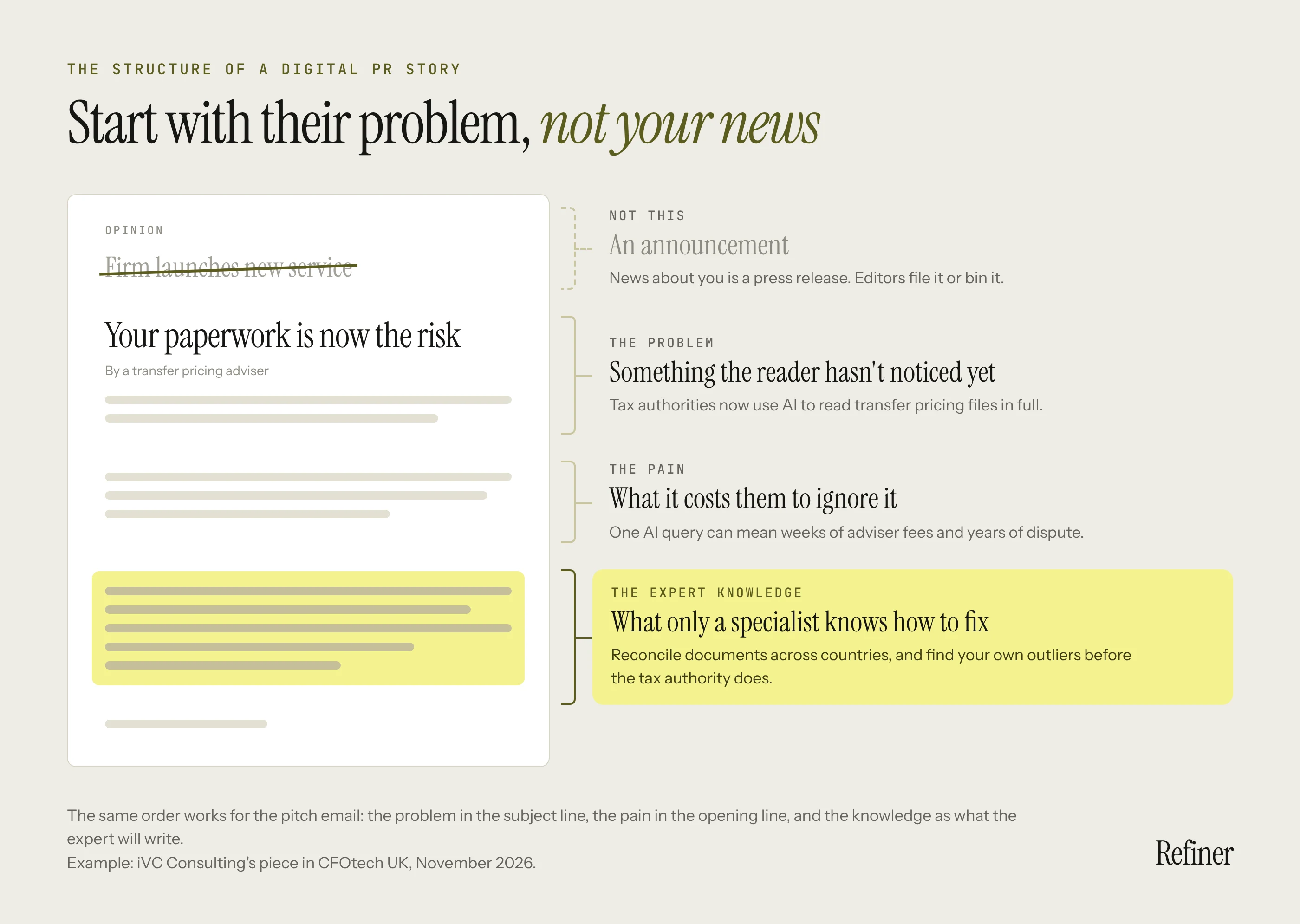
It didn't start with an announcement. It started with a problem most CFOs haven't noticed yet: tax authorities are using AI to read transfer pricing reports and intercompany agreements in full, rather than skimming them for the headline figures.
Then came the pain. The risk is no longer the price itself but the gaps between documents: a "limited-risk distributor" that books losses, or agreements that no longer match how the business actually works. Answering one AI-generated query can take weeks of management time and adviser fees, and can turn into years of dispute.
And then the knowledge only a specialist has: reconcile the documents across every country, update agreements and comparables each year, check your own outliers before the tax authority does, and know when an advance pricing agreement is worth it.
The piece drew 400% more readers than the average post. Anyone could have drafted the sentences. Nobody could have generated the insight, because it came from Arnas's work with finance teams on exactly this problem. That's the kind of story an editor is glad to get: a real expert, a specific problem and something the reader can act on.
Figure 1 sets out that structure. The same order works for the pitch that gets the piece commissioned.
What AI search changes
There's a second reason coverage matters more, and it has nothing to do with readers. When people ask ChatGPT, Claude or Gemini about a company or a category, the answer is built from what those tools read. Muck Rack's May 2026 study of more than 25 million cited links found earned media made up 84% of AI citations, and paid or advertorial content just 0.3% (Muck Rack, 2026).
Its December 2025 edition found two more things worth sitting with. Most AI citations for a given brand come from only about 20 outlets. And the overlap between the journalists PR teams pitch most and the ones AI engines cite most for that brand averaged just 2% (Muck Rack, 2025).
So a single story in the right outlet can shape what AI tells buyers for months. A hundred pieces in outlets the AI doesn't read do very little. Digital PR now has two audiences: the people who read the coverage, and the machines that read it on their behalf.
Digital PR in 2027 and beyond
Here is where I think it goes from here. These are my views, not forecasts anyone can prove yet.
Volume stops being a measure of anything. Sending more releases to more inboxes will get easier and work less well, as journalists filter harder and publishers block known offenders. The teams that do well will send fewer stories, to fewer people, who already know them.
Proof becomes the product. Original data, named experts with real track records, and customers willing to be quoted will be what gets coverage, because they are the only things AI can't produce on demand.
Coverage gets measured twice: once by who reads it, and again by whether it shows up when buyers ask AI about you. Knowing which 20 or so outlets shape the answers in your category will matter more than a long list of placements.
And the relationship becomes the moat. AI will write more of the first draft every year. The part that's left, being someone an editor trusts, is the part that's hardest to copy. It always was.
What is the future of digital PR?
The future of digital PR is fewer, better stories sent to people who already trust the sender. Most journalists now receive 50 or more pitches a week and say fewer than a quarter are relevant, while newsrooms keep shrinking. Original data, real experts and long-term relationships will win coverage, and that coverage will matter more because AI answers cite earned media heavily.
Do journalists accept AI-generated press releases?
Most don't want them. In Cision's 2026 State of the Media survey, 53% of journalists said they oppose receiving AI-generated pitches or press releases, and 21% were in favour. Journalists use AI themselves, but they worry about accuracy and fake experts. A release drafted with AI still needs real data, a real spokesperson and a sender the journalist trusts.
Does digital PR help with AI search?
Yes. Muck Rack's May 2026 study of more than 25 million links cited by ChatGPT, Claude and Gemini found earned media made up 84% of AI citations, against 0.3% for paid content. Coverage in the outlets AI tools read most for your category shapes what they say about your company, so digital PR now affects AI search as well as human readers.
“Everyone has news, and AI can write the release in a minute. But there are fewer places to cover it, journalists say most pitches miss, and earned coverage now makes up 84% of what AI answers cite. The future of digital PR belongs to relationships, not volume.”
Copy post gives you the takeaway and the link, ready to paste into LinkedIn.Lawford, A. (29 November 2026). The future of digital PR in 2027 and beyond. Refiner Agency. https://refineragency.com/insights/future-of-digital-pr