
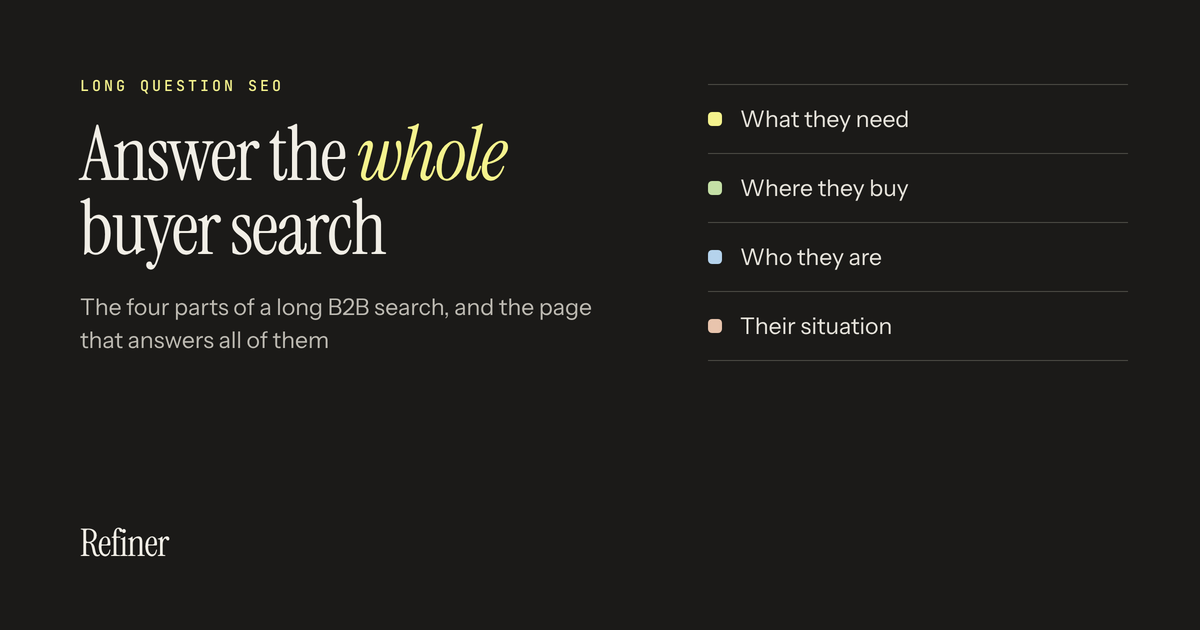
B2B buyers no longer search in two or three words. They type, or ask an AI assistant, a full sentence that carries their whole situation: what they need, where they buy, what kind of business they run and the constraint they're working under.
Long question SEO is the practice of answering those searches in full. It isn't a new trick. It is what a good sales conversation already does, written down on a page.
In this article
- Long question SEO starts with how B2B buyers search
- The four parts of a long B2B search
- The four parts change with what you sell
- Why a keyword page answers only one part
- How to write a page that answers all four
- How to find your long questions in Search Console
- Long question SEO in practice: two pages that rank first
- What is long question SEO?
- What are the four parts of a long B2B search?
- Do long searches bring less traffic than short keywords?
- How do you find long searches in Google Search Console?
Long question SEO starts with how B2B buyers search
In the 28 days to 23 November 2026, 43% of the searches that found our site in Google were eight words or longer. We ranked in the top five for them, at an average position of 5. For searches of one or two words, our average position was 33, on page four. We set out the full breakdown in our analysis of Google's November and December core updates.
Google is moving the same way. It said its December 2026 core update would improve ranking for longer, more complex questions. And when a buyer asks ChatGPT or Google's AI Mode, the assistant runs searches on their behalf that are often just as specific.
The opportunity is plain: every agency in the country competes for the short keyword, while very few pages answer the long question well.
The four parts of a long B2B search
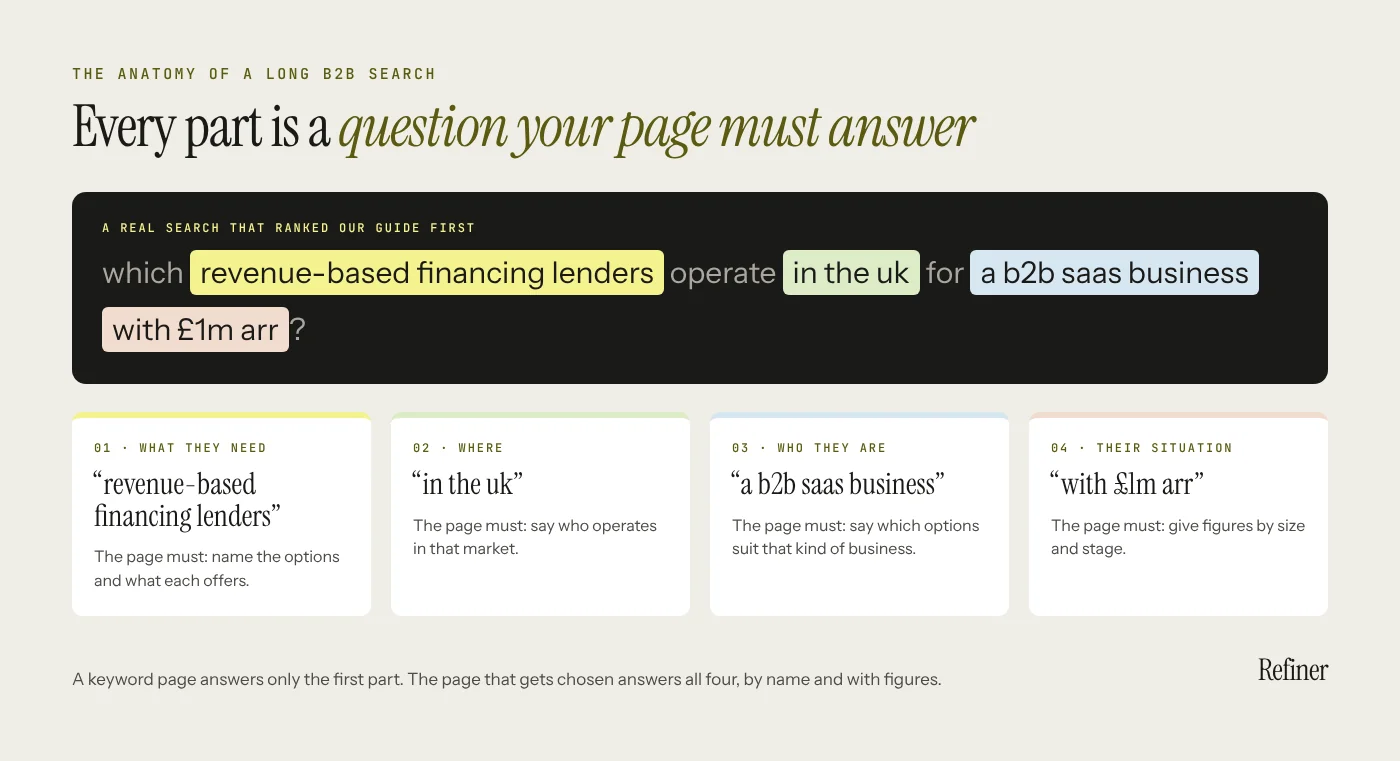
Almost every long B2B search is built from the same four parts. Take one that found our site: "which revenue-based financing lenders operate in the uk for a b2b saas business with £1m arr?"
- What they need: the product or service, in their words, not yours. Here, "revenue-based financing lenders".
- Where: the country or region they buy in. Here, "in the uk".
- Who they are: their kind of business, and often their role, such as "a new CMO". Here, "a b2b saas business".
- Their situation: size, growth, a deadline or a constraint, such as "without any downtime or seo loss". Here, "with £1m arr".
Each part narrows the answer. A lender that only funds US companies fails the second part. One that needs £5m of revenue fails the fourth.
The four parts change with what you sell
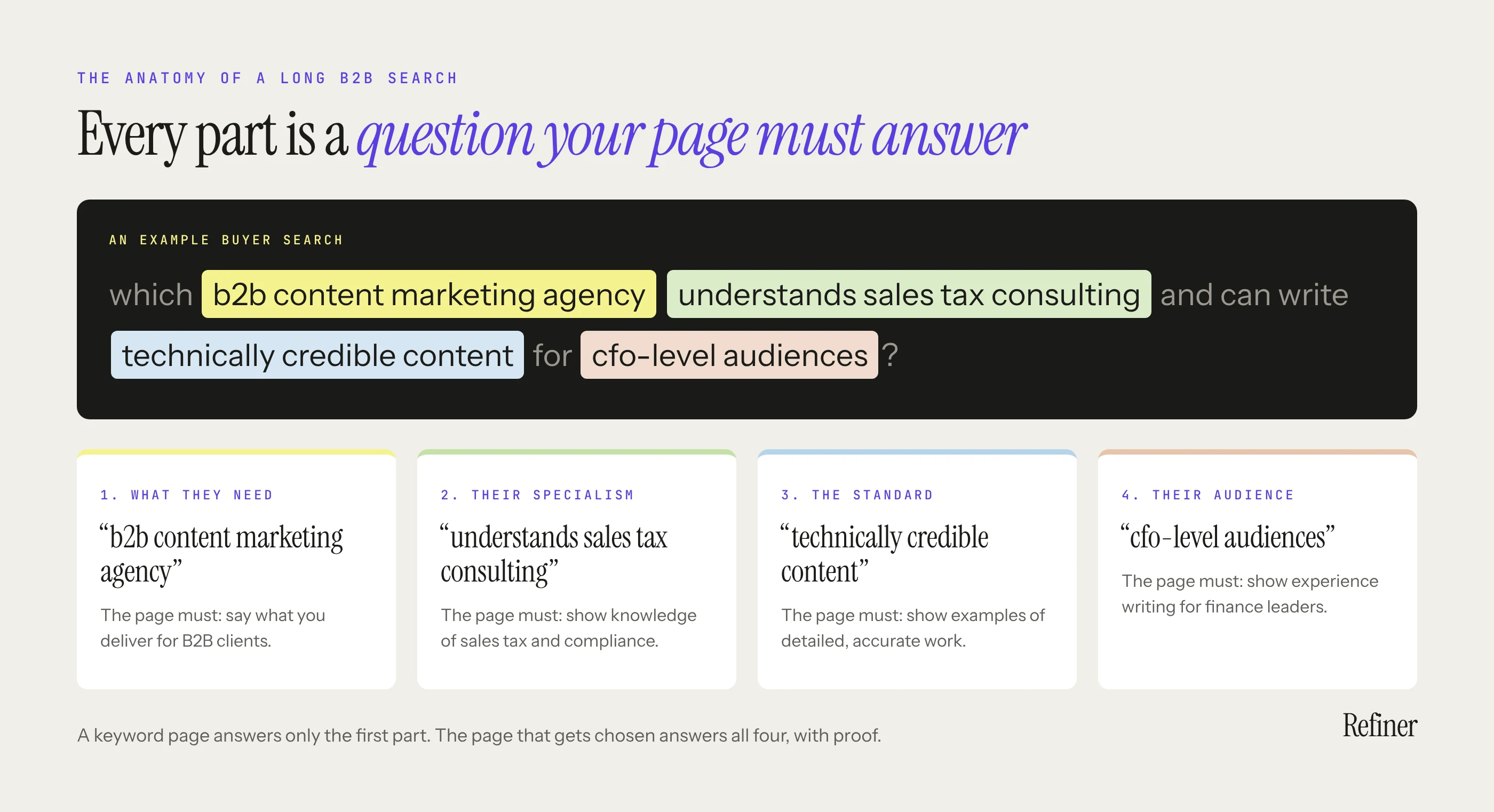
For services, the parts often look different. A buyer choosing an agency or adviser tells you their specialism, the standard they expect and who the work is for, rather than a place and a size.
- What they need: "b2b content marketing agency". The page must say what you deliver for B2B clients.
- Their specialism: "understands sales tax consulting". The page must show knowledge of sales tax and compliance.
- The standard: "technically credible content". The page must show examples of detailed, accurate work.
- Their audience: "cfo-level audiences". The page must show experience writing for finance leaders.
Here the answer isn't a list of figures. It is proof: a case study in the sector, samples of the work and the people who wrote it.
Why a keyword page answers only one part
A page written for a keyword answers the first part and stops. It explains what revenue based finance is, lists its benefits and asks for a call. The buyer still doesn't know which lenders operate in the UK, which of them fund SaaS, or which would look at a business their size.
Search engines and AI assistants look for the page that resolves the whole question. If yours answers one part in four, it loses to the page that answers all of them, even if your site is bigger and older.
How to write a page that answers all four
A page that wins long searches does four things:
- Names the options. It lists the real providers, products or approaches by name, not "a range of solutions".
- Says who each one suits. It matches each option to a kind of business, by sector, size and stage.
- Gives figures. Prices, funding ranges, timelines and thresholds, each with a date and a source.
- Covers the market it serves. It says which countries or regions each option operates in, and what changes there, such as regulation.
Then check the page against the searches themselves. Split each long search you want to win into its four parts, and find the sentence on your page that answers each one. If you can't point to it, write it.
This is the same principle behind structuring content for AI SEO: one question per section, the answer first, specific claims.
How to find your long questions in Search Console
You don't need to guess which long questions your buyers ask. Google Search Console already lists the ones your pages appear for.
- Open the Performance report and set the date range to the last three months.
- Add a Query filter, choose Custom (regex) and paste this pattern, which keeps searches of eight words or more:
^(\S+\s+){7,}\S+$- For searches written as questions, use this pattern instead:
(?i)^(which|what|how|who|where|can|does|is|should)\b- Sort by impressions, and split the top searches into their four parts.
The searches that show your pages but bring few clicks are the place to start. Google already thinks your page is relevant; it just doesn't answer the whole question yet.
Long question SEO in practice: two pages that rank first
Our comparison of UK revenue based finance lenders answers all four parts. It names each lender, says which kinds of business each one funds, and gives funding ranges and costs. It ranks first in Google for the lender question above, and for others about edtech, fintech and bootstrapped SaaS businesses.
Our guide to choosing a website redesign agency does the same for agency questions: it names the agencies, says what each one is strongest at and gives budget ranges for each size of project.
Neither page targets a keyword. Each one answers the questions a buyer in that situation asks.
What is long question SEO?
Long question SEO is optimising pages for the long, specific searches buyers type into Google or ask AI assistants, usually eight words or more. These searches carry the buyer's whole situation, so a page wins them by answering every part: what they need, where, who they are and their situation, with named options and figures.
What are the four parts of a long B2B search?
The four parts of a long B2B search are what they need, where, who they are and their situation. What they need is the product or service in the buyer's words. Where is the country or region. Who they are is their kind of business or role. Their situation is size, growth, a deadline or a constraint.
Do long searches bring less traffic than short keywords?
Yes, each long search is rare, but together they make up a large share of searches. In Refiner's Search Console data for the 28 days to 23 November 2026, searches of eight words or more were 43% of the searches listed and 22% of impressions. We ranked at an average position of 5 for them, against 33 for one or two word searches.
How do you find long searches in Google Search Console?
Long searches in Google Search Console are found with a regex query filter. In the Performance report, add a Query filter, choose Custom (regex) and paste a pattern that keeps searches of eight words or more, like the one in the steps above. Sort by impressions, then split each search into its four parts to see what your page must answer.
“Almost every long B2B search has four parts: what they need, where, who they are and their situation. A keyword page answers one. The page that gets chosen answers all four, by name and with figures.”
Copy post gives you the takeaway and the link, ready to paste into LinkedIn.Lawford, A. (27 November 2026). Long question SEO: answering the whole buyer search. Refiner Agency. https://refineragency.com/insights/long-question-seo