
This guide is for B2B marketing leads and founders who want buyers, and the AI tools buyers now ask, to trust what their company says about itself. It explains the three layers that brand authority is built from, what each one can and can't do, how to build them in order, and how to check they agree. Sources were checked on 29 November 2026.
The framing comes from a diagram by Dev Basu, founder of Powered By Search, which draws brand authority as rings built from the inside out: the website, then the channels you run, then the sources only others can write. It's a useful way to see an older idea, and this post builds on it.
The example used throughout is an illustration, not a client: a 40-person HR software company in San Francisco that sells to US companies with 20 to 200 employees. Its buyers are HR managers and finance directors who compare three or four products before they book a demo.
In this article
- 1. Defining the three layers of brand authority
- 2. Why buyers and AI answers check the outer layers
- 3. Making the claim on your website
- 4. Repeating it, word for word, on your channels
- 5. Earning the third-party sources
- 6. Checking the three layers agree
- 7. Brand authority checklist
- What is brand authority in B2B marketing?
- What is the difference between owned, shared and earned media?
- Do third-party mentions help a company appear in AI answers?
- Should every company profile use the same wording as the website?
1. Defining the three layers of brand authority
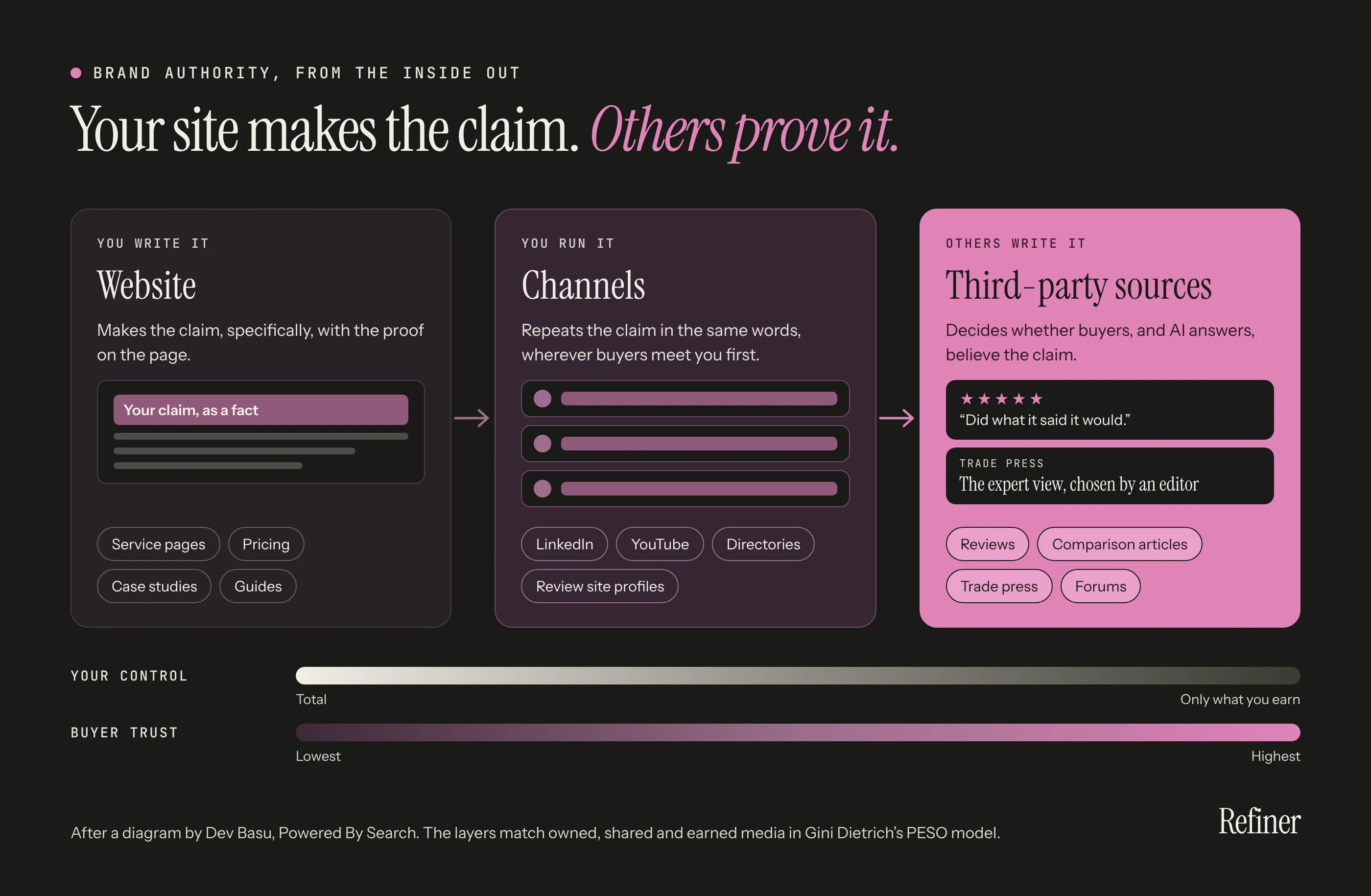
Each layer is defined by who writes it. Table 1 sets them out.
| Layer | Who writes it | Examples | Its job |
|---|---|---|---|
| Website | You, entirely | Service and product pages, pricing, case studies, guides | Make the claim, specifically |
| Channels | You, on someone else's platform | LinkedIn, YouTube, directory listings, review site profiles | Repeat the claim, in the same words |
| Third-party sources | Other people | Reviews, comparison articles, trade press, forums such as Reddit | Decide whether the claim is believed |
Brand authority here means how far buyers, and the AI tools they ask, trust what you say about yourself enough to act on it. It's not the same as awareness: plenty of companies are known and not believed.
The layers map onto an established model. Gini Dietrich's PESO model, introduced in her 2014 book Spin Sucks, sorts media into paid, earned, shared and owned (Spin Sucks). The website is owned media, channels are shared media, and third-party sources are earned. Spin Sucks puts it as owned content being the foundation, which shared media distributes and earned media reinforces (Spin Sucks). Paid media sits outside this post, because it buys attention rather than trust.
Figure 1 shows the three layers side by side, with how much you control each and how much buyers trust it.
2. Why buyers and AI answers check the outer layers
What's established, with sources:
- AI answers mostly cite what others write. Muck Rack's May 2026 study of more than 25 million links cited by ChatGPT, Claude and Gemini found 84% came from earned sources, and paid or advertorial content made up 0.3% (Muck Rack, 2026). Muck Rack counts journalism, academic research, government sites, encyclopedias and other companies' content as earned, so the category is broad.
- Buyers check after an AI recommends someone. In Semrush's survey of US business professionals, 71% visited the vendor's website after an AI recommendation, 63% searched for the company on Google, 46% compared it with alternatives and 38% checked reviews on G2 or similar sites (Semrush, 2026).
- Reviews weigh more as the decision nears. G2 found review sites gain influence as buyers move from consideration to decision (G2, 2026).
Our view, which these figures support but don't prove: a buyer reads your website to learn what you claim, and reads everything else to find out whether it's true. AI answers work the same way, at scale. Your own pages tell them what you do; other people's pages tell them whether to recommend you.
For the San Francisco HR software company, that means its homepage can say "payroll and holiday tracking set up in a day", but the claim only counts once a comparison article, a G2 review or an HR forum thread says the same.
3. Making the claim on your website
The website is the only layer you fully control, so it has to carry the claim clearly enough that everything else can repeat it.
- Write the claim as a fact, not a slogan. "HR software for US companies with 20 to 200 employees" can be repeated, checked and quoted. "People-first HR" can't.
- Give the evidence on the same page. Named customers, figures with dates, and case studies that say what changed. A claim with no proof on the page gives third parties nothing to confirm.
- Keep one fact sheet. What you do, who for, what it costs or how pricing works, where you operate, and your current name. Every other layer copies from it.
- Answer the questions buyers ask. Pages that answer "how much does HR software cost for a 50-person company?" in the first sentence are the ones AI answers quote. Our guide to structuring content for AI SEO covers the format.
For the San Francisco company, the fact sheet fits on one page: who it's for, the three things it does, the price per employee, the federal and state payroll rules it handles, and three named customers with the result each one saw.
4. Repeating it, word for word, on your channels
Channels are profiles you run on platforms you don't own. Their job is to say exactly what the website says, so a buyer who meets you there first gets the same story.
- Copy the claim, don't rewrite it. Use the fact sheet's wording on LinkedIn, YouTube, directory listings and your review site profiles. Different wording on every profile reads as a different company.
- Fill in every field. Category, company size, location, pricing model, website link. Directories and review sites sort and filter by these fields, and empty ones drop you out of filtered lists.
- Claim the review site profiles. Your G2 or Capterra profile is a channel: you write the description. The reviews on it are not, which is why they sit in the next layer.
- Check them on a schedule. Profiles drift: an old price, a product you've retired, last year's logo. Put a quarterly check in the diary.
For the San Francisco company, that's five profiles: LinkedIn, YouTube, G2, Capterra and one HR software directory, each with the same one-line description and the same three proof points.
5. Earning the third-party sources
This is the layer you can't write, so you earn it by giving others something true and useful to say.
- Reviews. Ask customers soon after a good result, and make it easy with a direct link. Ask for detail ("what changed for you?"), not stars. Never write, buy or quietly reward reviews: in the US, the FTC's rule banning fake reviews and paid-for positive reviews took effect on 21 October 2024 (FTC, 2024), and the UK has banned fake and concealed incentivised reviews since 6 April 2025 (CMA, 2025). Our guide to marketing a compliance business covers review programmes in more detail.
- Comparison articles. Buyers search "X vs Y" and "best X for Z", and AI answers draw on the pages that rank for them. Publish an honest comparison on your own site, and make sure the independent ones have your current facts. Our guide to finding comparison searches in Search Console shows how to find which ones matter.
- Trade press. An expert's article in a publication your buyers read is the strongest proof there is, because an editor chose to run it. Our piece on the future of digital PR covers what makes those stories land.
- Forums and communities. Buyers ask each other on Reddit and in industry groups. Take part as yourself, say who you work for, follow each community's rules, and answer questions rather than promote.
For the San Francisco company, the first targets are 20 detailed G2 reviews, a place in the two independent "best HR software for small business" articles that rank highest, and one article by its founder in an HR trade publication on a change in US employment law, such as a new state pay transparency rule.
6. Checking the three layers agree
Authority breaks where the layers disagree: the website says one price, a directory says another, and a review mentions a product you no longer sell. Run this check every quarter.
- Read your fact sheet. It's the version every layer should match.
- Check each channel against it. Note every difference in wording, price, size or name.
- Search for your company the way a buyer would. Your name with "reviews", "pricing", "vs" and your main competitor's name.
- Ask AI tools about you. "What does [company] do?", "Is [company] any good?", "[Company] vs [competitor]". Read the answers against the fact sheet. Our guide to tracking AI mentions by funnel stage explains how to make this a repeatable measure rather than a one-off look.
- Fix from the inside out. Correct the website first, then the channels, then ask the authors of third-party pages to update what's wrong.
7. Brand authority checklist
Before you spend on reach, check that:
- your website states the main claim as a fact, with proof on the same page;
- one fact sheet holds what you do, who for, pricing, location and your current name;
- every profile you run uses the fact sheet's wording, with every field filled in;
- you've claimed your profiles on the review sites your buyers use;
- you ask customers for detailed reviews soon after a good result;
- your facts are current in the comparison articles that rank for your category;
- someone owns one piece of trade press coverage a quarter;
- AI answers about you are checked against the fact sheet every quarter.
For the San Francisco HR software company, the first three items take a week. The rest is a standing programme, and it's where most of the authority comes from.
What is brand authority in B2B marketing?
Brand authority in B2B marketing is how far buyers trust what a company says about itself enough to act on it. It's built in three layers: the website makes the claim, the profiles the company runs repeat it, and reviews, comparison articles and press coverage confirm it. Awareness is being known; authority is being believed.
What is the difference between owned, shared and earned media?
Owned media is what a company publishes on its own website. Shared media is what it posts on platforms it doesn't own, such as LinkedIn or YouTube. Earned media is what others say about it, such as reviews and press coverage. The terms come from Gini Dietrich's PESO model, introduced in 2014, which adds paid media as a fourth type.
Do third-party mentions help a company appear in AI answers?
Yes. Muck Rack's May 2026 study of more than 25 million links cited by ChatGPT, Claude and Gemini found 84% came from earned sources, such as journalism and other companies' content, and 0.3% from paid content. AI answers lean on what others say about you, so reviews, comparisons and press coverage matter alongside your own pages.
Should every company profile use the same wording as the website?
Every company profile should use the same core wording as the website: the same one-line description, the same category, the same pricing model and the same proof points. Buyers meet you on LinkedIn, review sites and directories before they visit, and different wording on each reads as a different company. Keep one fact sheet and copy from it.
“Brand authority is built from the inside out. Your website makes the claim, your channels repeat it word for word, and third parties decide whether anyone believes it. Muck Rack found 84% of AI citations come from earned sources.”
Copy post gives you the takeaway and the link, ready to paste into LinkedIn.Lawford, A. (29 November 2026). Building brand authority from the inside out. Refiner Agency. https://refineragency.com/insights/brand-authority-inside-out