
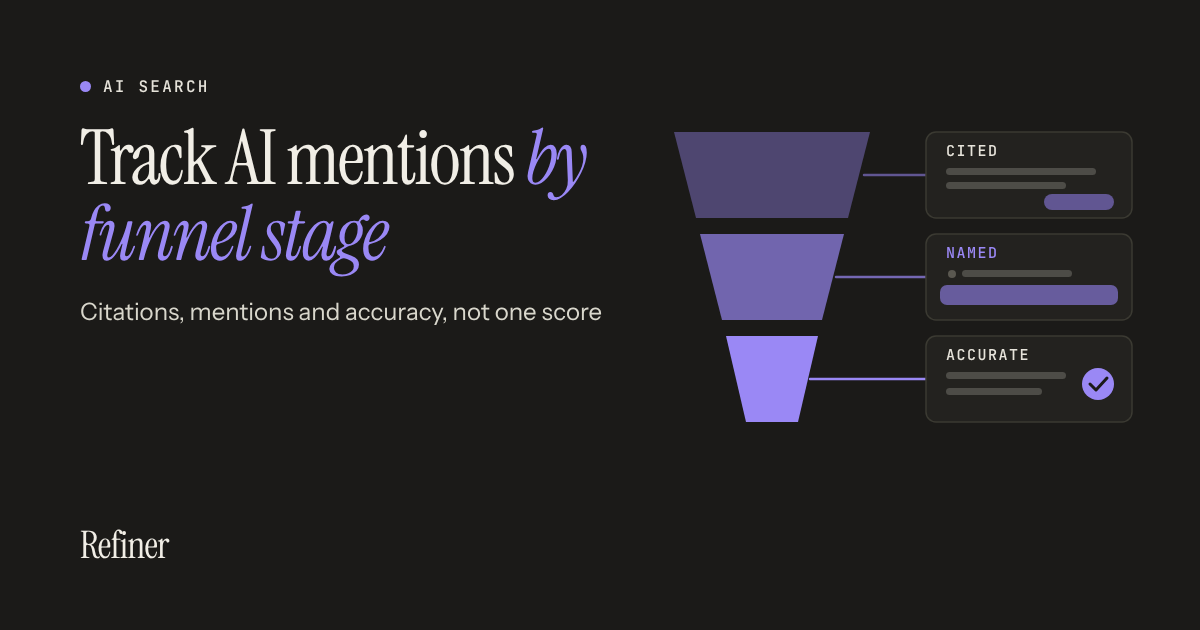
This guide is for B2B marketing leads who track, or are about to track, how their company appears in ChatGPT, Gemini, Copilot, Perplexity and Google's AI features. It explains why to split that tracking into three funnel stages (awareness, consideration and purchase), how to write the prompts for each, what to measure, which tools help, and what to fix when a stage comes up short. Sources and tool details were checked on 29 November 2026.
The example used throughout is Kord, an FCA-regulated compliance platform that brings client onboarding, identity verification, anti-money laundering (AML) checks, document signing and payments together for law firms and conveyancers, estate and letting agents, and financial services firms. We worked with the business from August 2024 to March 2025, when it was called Checkboard, as our case study sets out. It has since renamed its business platform Kord, keeping Checkboard for its consumer app, and we don't work with it now. We use Kord's market because it shows each stage clearly, and a renamed company is a good test of purchase-stage answers. The prompts are ours, written to illustrate the method: the post contains no Kord tracking data and isn't advice we've given Kord.
In this article
- 1. Defining the three funnel stages for AI answers
- 2. Why one AI visibility score hides where you lose buyers
- 3. Building the prompt set for each stage
- 4. Choosing the right measure at each stage
- 5. Choosing tools that track AI discovery
- 6. Running each prompt enough times to trust the number
- 7. Fixing what each stage shows
- 8. Reporting AI mentions by funnel stage
- 9. AI mentions by funnel stage checklist
- Why should I track AI mentions by funnel stage?
- What is the difference between an AI mention and an AI citation?
- How many times should I run each AI visibility prompt?
- Can I track my ranking position in ChatGPT answers?
1. Defining the three funnel stages for AI answers
Each stage is a different kind of question, and AI tools answer each kind differently. Table 1 sets out the pattern, with a placeholder and a Kord example for each.
| Stage | What the buyer asks about | Prompt pattern | Kord example | What to measure |
|---|---|---|---|---|
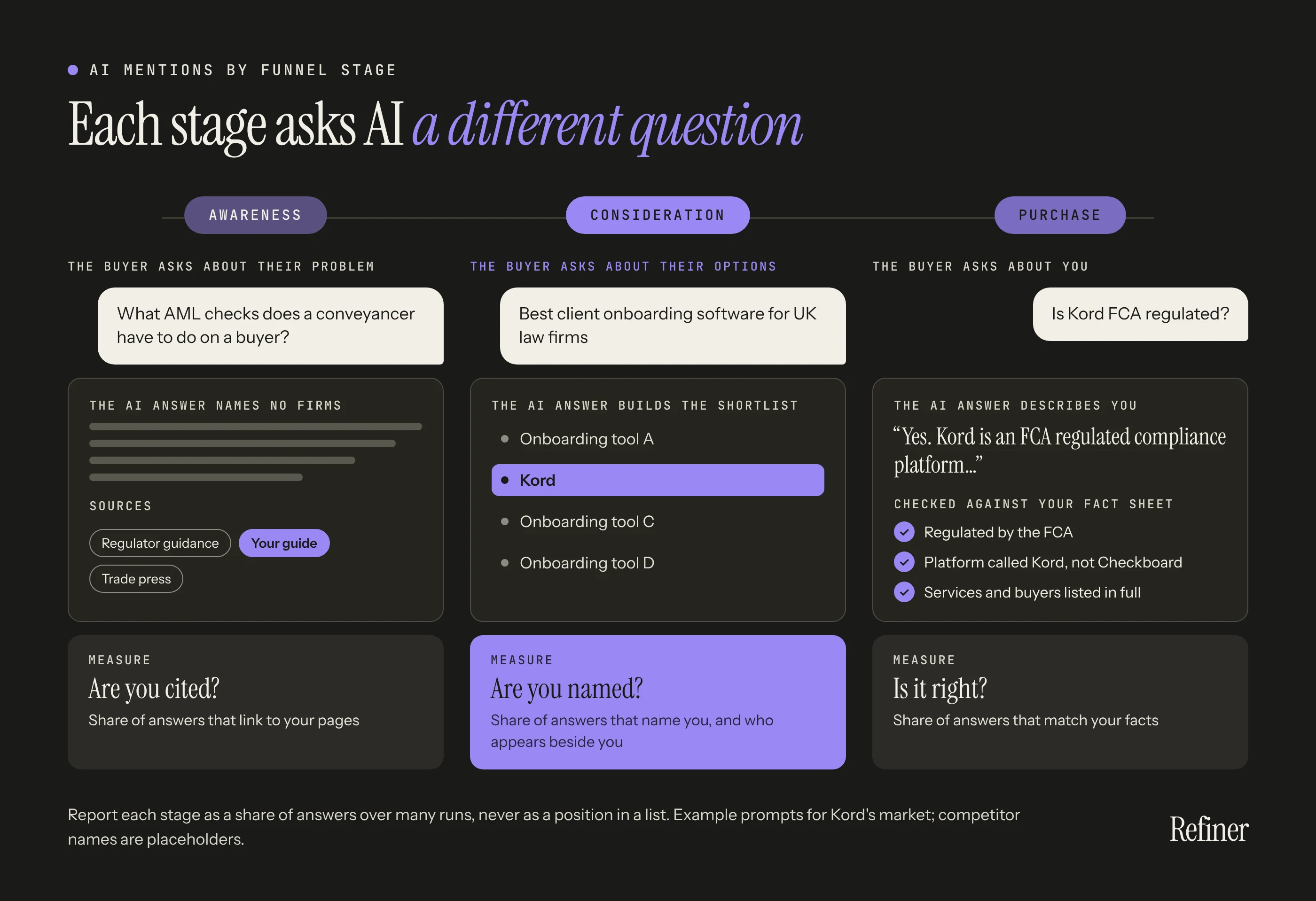
| Awareness | Their problem | What does [rule or problem] mean for [type of business]? | What AML checks does a conveyancer have to do on a buyer? | Citation rate: the share of answers that link to your pages |
| Consideration | Their options | Best [category] for [type of business], or [you] vs [competitor] | Best client onboarding software for UK law firms | Mention rate: the share of answers that name you, and who is named beside you |
| Purchase | You | [Brand] pricing, reviews, or "is [brand]…" | Is Kord FCA regulated? | Accuracy: whether the answer matches the facts about you |
A mention is your brand's name in the answer. A citation is a link to one of your pages as a source. An answer can cite you without naming you, which is common at the awareness stage, or name you without citing you, which is common when the AI draws on review sites and lists.
Figure 1 shows the three stages side by side for Kord's market: the question, what the AI answer does with it, and the measure that fits.
2. Why one AI visibility score hides where you lose buyers
Buyers use AI at every stage, so it's tempting to track one number for all of it. In Semrush's survey of 519 US business professionals who use AI for work (March to April 2026), 72% used AI for early research, 62% to compare vendors, 48% to narrow the shortlist and 45% to support the final decision (Semrush, 2026). G2's March 2026 survey of 1,076 B2B software buyers found that AI chatbots are now the top source influencing shortlists, and that 69% of buyers chose a different vendor from the one they first planned because of a chatbot's recommendation (G2, 2026). Both surveys cover software buyers, mostly in the US, so treat them as a direction rather than a measure of UK professional services buyers.
The problem with one score is that the stages behave differently. Conductor ran 14,000 API calls across four AI engines and seven types of intent (Conductor, 2026):
- Educational prompts, the awareness stage, named no brands at all in 45% to 72% of answers, depending on the engine.
- Comparison prompts were the most consistent: the same brand led 91% of the time.
- Purchase prompts were the least consistent, with only about four in ten brands appearing in both of two runs.
Add those together and a strong awareness presence can hide a weak shortlist position, or the reverse. If Kord's pages were cited in plenty of answers about AML rules but Kord was rarely named in answers about onboarding software, one blended score could still look healthy. Split by stage, it would show that the content educates buyers and someone else gets the shortlist.
3. Building the prompt set for each stage
Write the prompts before you choose a tool, so the tool tracks your buyers' questions rather than its own suggestions.
- Collect real questions first. Take them from sales and discovery calls, long queries in Search Console, "People also ask" boxes and the questions in enquiry forms. Our guide to long question SEO shows how to find the long ones in Search Console.
- Sort each question into one stage. Ask what the buyer already knows. If they don't yet know suppliers exist, it's awareness. If they're comparing suppliers, it's consideration. If they name you, it's purchase.
- Write 20 to 30 prompts per stage. Fewer than that and one odd answer moves the result. Keep the buyer's wording, including the type of business and the country.
- Name your competitors in some consideration prompts. "Kord vs [competitor] for conveyancers" tests whether you appear in the comparisons buyers actually run.
- Include your old name in purchase prompts if you've rebranded. Kord kept the Checkboard name for its consumer app, so a buyer could fairly ask "Is Checkboard the same as Kord?". That prompt tests whether answers describe the business platform under its new name.
- Freeze the set for at least a quarter. Changing prompts every month makes trends meaningless. Add new prompts at the start of a quarter, and note when you did.
For a company in Kord's market, a starter set might look like this:
- Awareness: "What AML checks does a conveyancer have to do on a buyer?", "How do estate agents verify a client's identity?", "What are the source of funds rules for UK law firms?"
- Consideration: "Best client onboarding software for UK law firms", "AML check software for estate agents", "Kord vs [competitor] for conveyancers"
- Purchase: "Is Kord FCA regulated?", "How much does Kord cost?", "Is Checkboard the same as Kord?"
4. Choosing the right measure at each stage
Each stage needs a measure that matches what the AI does there.
- Awareness: citation rate. Count the answers that link to one of your pages, out of all answers to your awareness prompts. Brand mentions are rare here, so a low mention rate at this stage isn't a problem in itself. A low citation rate is: it means the AI is learning about the problem from someone else's pages.
- Consideration: mention rate and company. Count the answers that name you, and record who else is named. This is where the shortlist forms, so it's the stage closest to the pipeline. Don't report your position in the list, for the reasons in section 6.
- Purchase: accuracy and tone. Write a short fact sheet first: what you do, who for, where you're regulated, how pricing works and your current name. Then read the answers against it. For a company in Kord's position, an answer that calls the business platform by its old name, or leaves out the FCA regulation, is a purchase-stage failure, even though it names the brand.
5. Choosing tools that track AI discovery
No single tool covers every engine and every measure, and none of those below sorts prompts into funnel stages for you, as far as their public pages show. Tag each prompt with its stage yourself and filter on the tag. Table 2 compares the options.
| Tool | What it shows | Most useful for | Cost |
|---|---|---|---|
| Searchable | Mentions, citations, sources and sentiment for your prompts, and which competitors appear instead | All three stages, across eight AI engines | From $125 a month |
| Bing Webmaster Tools | Citations of your pages in Copilot and Bing AI answers, with the queries behind them sorted by intent | Awareness citations | Free |
| Semrush and Ahrefs | AI visibility alongside their SEO data | Teams already paying for one of them | Ahrefs' Brand Radar from $199 a month on top of a plan |
| Muck Rack | How often a brand appears in ChatGPT, Claude and Gemini answers, next to press coverage | PR teams tracking earned media | Ask Muck Rack |
| Google Search Console | Clicks and impressions from Google, with AI Overviews and AI Mode included in web search | Checking whether AI features send visits | Free |
- Searchable tracks ChatGPT, Claude, Perplexity, Google AI Overviews, Microsoft Copilot, Gemini, Grok and DeepSeek. Its Prompt Universe maps the questions buyers could ask about a market, and its reports separate mentions from citations and show which competitors appear in your place (Searchable). That split maps directly onto the awareness and consideration measures above.
- Bing Webmaster Tools is the only free, first-party source of citation data here. Its AI Performance report shows which of your pages Copilot and Bing's AI answers cite (Bing, February 2026). Since June 2026 it also sorts the queries behind those citations by intent, such as informational, commercial and navigational, and shows your share of the citations for each query (Bing, June 2026). Those intents are a rough match for the three stages.
- Semrush and Ahrefs add AI visibility to the SEO data many teams already have (Ahrefs pricing). Our comparison of AI SEO tools covers what each costs.
- Google Search Console counts visits from AI Overviews and AI Mode within web search, but doesn't separate them (Google Search Central). Use it to see whether AI features send visits, not to measure mentions.
For a firm like Kord, Bing Webmaster Tools plus one paid tracker covers all three stages. Start with Bing's AI Performance report, which costs nothing to set up, and add a paid tracker such as Searchable once your prompts are written.
6. Running each prompt enough times to trust the number
AI answers change every time you ask. SparkToro had 600 volunteers run 12 prompts 2,961 times across ChatGPT, Claude and Google's AI (SparkToro, January 2026). Two results stand out:
- ChatGPT and Google's AI gave the same list of brands twice less than once in 100 runs.
- The same list in the same order came up less than once in 1,000 runs.
That makes a position in an AI answer meaningless as a metric. The researchers concluded that the share of answers that include a brand, over many runs of many prompts, is a reasonable measure, and suggested roughly 60 to 100 runs per prompt.
In practice:
- Report shares, not positions. "Named in 18% of consideration answers" holds up. "Ranked third in ChatGPT" doesn't.
- Ask your tool how often it runs each prompt. Fewer runs mean a noisier number, so treat small monthly changes as noise.
- Compare quarters, not weeks. A trend across three months tells you more than any single report.
- Keep the engines fixed. Adding an engine changes the total, so note when you did.
7. Fixing what each stage shows
Each stage that comes up short needs a different fix, and the measure tells you which.
Low awareness citations: write the answer to the problem. The AI is learning about the problem from other pages. Publish clear, specific guides that answer the awareness prompts in the first sentence, with dates and sources. For Kord's market, that's a guide to the AML checks a conveyancer runs on a buyer, written by someone who knows the rules. Our guide to structuring content for AI SEO covers the format. Coverage in trade press helps too, because AI answers draw on the publications buyers already trust; our piece on the future of digital PR covers what makes those stories land.
Low consideration mentions: be in the places shortlists come from. This is usually the gap that costs the most. Publish comparison pages for the comparisons buyers run, with honest tables and named alternatives. Our guide to finding comparison searches in Search Console shows how to find which ones. Then work on what you don't control: industry lists, review sites and case studies. G2 found review sites gain influence as buyers move from consideration to decision (G2, 2026).
Inaccurate purchase answers: fix the facts at the source. In Semrush's survey, 71% of buyers visited the vendor's website after an AI recommendation, and 38% checked review sites (Semrush, 2026). Make sure your own site states the facts from your fact sheet plainly: what you do, who for, how pricing works, where you're regulated, and your current name. Update the profiles you control on review sites, directories and LinkedIn to match. For a company in Kord's position, that means one clear line on its site saying which product carries which name.
8. Reporting AI mentions by funnel stage
Report one line per stage, with the measure, this quarter's share, last quarter's share and the action it leads to. Table 3 shows the layout.
| Stage | Measure | Last quarter | This quarter | Action |
|---|---|---|---|---|
| Awareness | Share of answers citing your pages | [%] | [%] | Which guides to write or update |
| Consideration | Share of answers naming you, and who else is named | [%] | [%] | Which comparisons, lists and reviews to work on |
| Purchase | Share of answers that match your fact sheet | [%] | [%] | Which facts to correct, and where |
Lead with the consideration line when you report to a board or a CFO, because it sits closest to enquiries. Put enquiries and pipeline from the same period next to it, so the AI measure is read as an early signal, not a result. Our guide to defending the marketing budget to a CFO covers how to present early signals like this.
9. AI mentions by funnel stage checklist
Before you start tracking, check that:
- every prompt comes from a real buyer question, not a keyword list;
- each prompt is tagged awareness, consideration or purchase;
- each stage has 20 to 30 prompts, frozen for at least a quarter;
- some consideration prompts name your competitors;
- purchase prompts include any old brand names;
- you have a one-page fact sheet to check purchase answers against;
- Bing Webmaster Tools is set up, and its AI Performance report is on;
- your tool reports shares of answers, run many times, not positions;
- each stage's result leads to a named action and an owner.
For a company like Kord, the fact sheet and the Bing setup would take an afternoon. The prompt set takes longer, because the best questions come from the sales team.
Why should I track AI mentions by funnel stage?
Tracking AI mentions by funnel stage shows where buyers lose sight of you. Awareness answers often name no brands, consideration answers build the shortlist, and purchase answers describe you, so one blended score can look healthy while you're missing from shortlists. Split by stage, each gap points to a different fix: guides for awareness, comparisons and reviews for consideration, and corrected facts for purchase.
What is the difference between an AI mention and an AI citation?
An AI mention is your brand's name in an AI answer, and an AI citation is a link to one of your pages as a source. An answer can cite your guide without naming you, which is common in answers about a problem, or name you without linking to you, which is common when it draws on review sites. Track citations for awareness prompts and mentions for consideration prompts.
How many times should I run each AI visibility prompt?
Run each AI visibility prompt dozens of times, not once. SparkToro's January 2026 study found ChatGPT and Google's AI repeated the same list of brands less than once in 100 runs, and suggested roughly 60 to 100 runs per prompt. Ask your tracking tool how often it runs each prompt, report the share of answers that include you, and compare quarters rather than weeks.
Can I track my ranking position in ChatGPT answers?
No, not reliably. SparkToro's 2026 research found the same brands in the same order came up less than once in 1,000 runs of a prompt, so a position in ChatGPT's list changes almost every time. Track how often ChatGPT names you across many runs and many prompts instead, and record which competitors it names beside you.
“Track AI mentions by funnel stage, not as one score. Awareness answers rarely name brands, so measure citations. Consideration answers build the shortlist, so measure how often you're named. Purchase answers describe you, so check they're right.”
Copy post gives you the takeaway and the link, ready to paste into LinkedIn.Lawford, A. (29 November 2026). How to track AI mentions by funnel stage. Refiner Agency. https://refineragency.com/insights/track-ai-mentions-by-funnel-stage